
In 2016, many Indians still treated mobile data as a rationed utility. You checked your balance before playing a video. You looked for Wi-Fi before a video call. You queued at a cyber cafe to print a form, upload a document or send a long email.
Then the meter started disappearing from everyday decisions. This installment of the Jio Story looks at the small, personal shifts between 2016 and today—less about infrastructure, more about the shape of an ordinary day.
Then: data as a limited resource
Before the unlimited era, being online was often a scheduled activity. You downloaded songs at night, saved videos to watch offline, and treated streaming as a rare luxury. The cyber cafe was the backup office for anyone without a dependable home connection.
A family often shared one screen and one plan. The question in the air was practical: ‘How much does data cost?’
The hinge: 2016 and the Welcome Offer
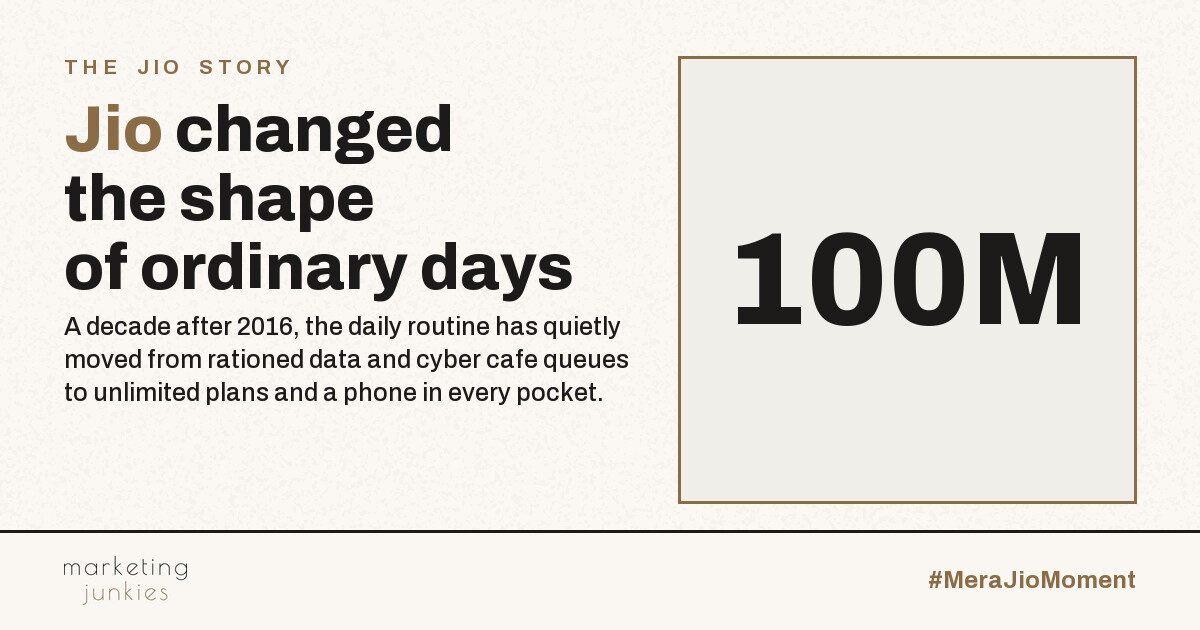
In 2016, Jio launched with the Welcome Offer: unlimited 4G data, voice, video and apps, as Reliance Industries described it. The company reported reaching 100 million subscribers within 170 days of launch.
That scale signalled a shift in behaviour. India’s question began moving from ‘How much does data cost?’ to ‘What can we do with data?’—the question this series keeps returning to.
Now: the phone in every pocket
The cyber cafe line, the download queue and the shared desktop did not vanish overnight. They were replaced by quieter defaults:
- The top-up queue became a plan that simply renews.
- The cyber cafe login became an app on the phone in your pocket.
- “Download to watch later” became “stream now” in the next free minute.
- The family desktop became a screen per person, each with its own feed.
Today, Jio serves 524 million+ customers, as the company reported in March 2026. At Reliance Industries’ 48th AGM in August 2025, the ecosystem was described as spanning connectivity, entertainment, commerce, payments, devices, cloud and AI. Its stated priorities included connecting every Indian, bringing digital services home, digitising businesses, and “AI Everywhere for Everyone.”
The marketing shift
For marketing and media professionals, the meaningful change is not the network. It is the audience’s relationship with time and attention. When data stops being a meter, content becomes ambient—people scroll in queues, watch during lunch, and finish a transaction on a second screen.
Campaigns built for a careful, rationed user look dated in a feed where the next short video is always one swipe away. The brief no longer starts with saving data; it starts with earning attention.
The change is still visible in the smallest moments: a shopkeeper checking a payment on the phone, a student attending a class from a village, a parent video-calling without waiting for the weekend. The shift lives in ordinary life.