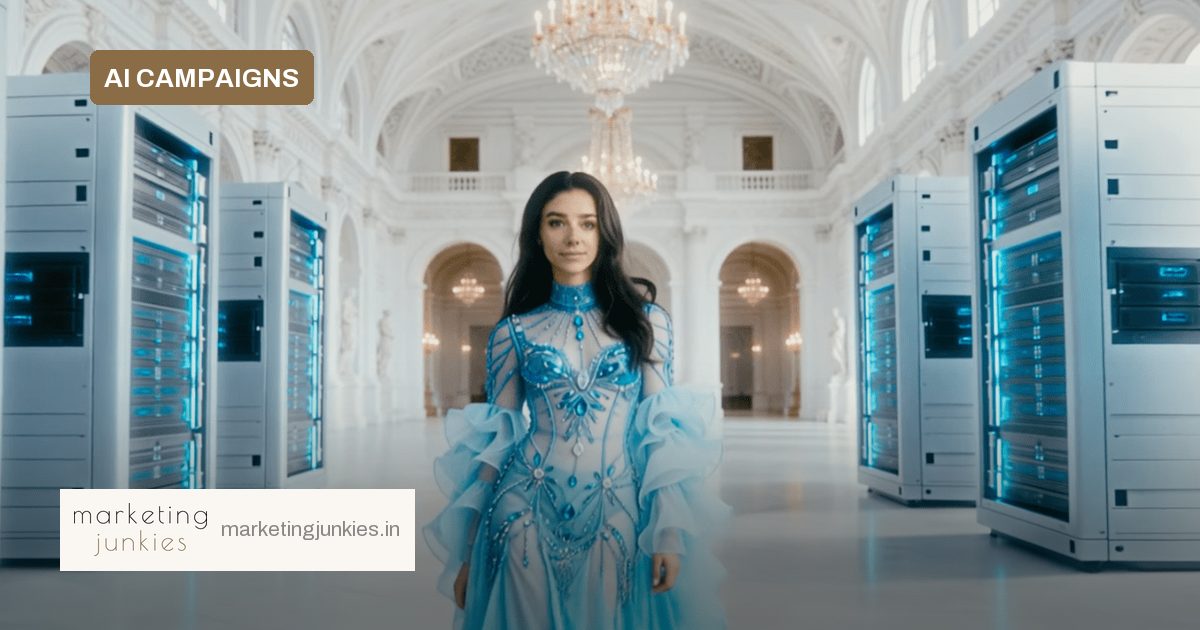
An AI-generated actress created by production company Particle6 Group is making headlines for the wrong reasons. Tilly Norwood, built to promote the upcoming film Misaligned, has been made available for 75 simultaneous press interviews. Instead of demonstrating a breakthrough in synthetic media, the tour has produced a series of awkward errors, including an on-camera shift into Chinese.
What happened on the press tour
In one interview with Piers Morgan and actor Tom Conti, Norwood initially misunderstood a question about whether other cast members were real or AI-generated. The bot first pointed to human writers, editors, and directors before being asked again. It then began to explain that the other actors were “digital twins” in a hybrid production, stopped mid-sentence, and spoke in Chinese for more than ten seconds.
Morgan asked why the AI had switched languages. Norwood apologised and described the moment as “a little hiccup,” adding that its “wires get a bit crossed” sometimes.
Why this matters for marketers
AI-created spokespeople and virtual influencers are moving from novelty to campaign tool. The appeal is scale: one digital persona can appear in dozens of interviews, adapt to local languages, and run around the clock. But this press tour shows that scale amplifies mistakes too. A single glitch does not stay in one room; it becomes shareable content across platforms.
For marketing teams, the lesson is less about the technology failing and more about planning for failure. If you deploy a synthetic spokesperson, you need clear guardrails, a human operator, and a rapid-response plan.
- Test for adversarial prompts: Interviewers will ask clarifying and follow-up questions. Scripted answers are not enough.
- Monitor every live appearance: A 75-interview simultaneous push multiplies risk.
- Have a human escalation path: Someone should be able to pause, correct, or end an interview if the system breaks.
- Turn errors into transparency: A quick acknowledgment can reduce the spread of misleading clips.
Was this a deliberate publicity play?
The contradictions have led TechCrunch to wonder whether the flawed tour is itself a deliberate attention strategy. If the goal was to make Tilly Norwood a punchline, the coverage is working. If the goal was to build credibility for the film, the result is far less clear. Either way, marketers should be wary of confusing attention with trust.
The takeaway
Norwood’s press tour resembles a raw conversational interface placed in a high-pressure interview setting. For brands exploring AI talent, ask whether the character has a voice, a content calendar, and a risk playbook, not just a language model. If the only advantage is scale, the downside may arrive at scale too.
Source: TechCrunch