
The campaign
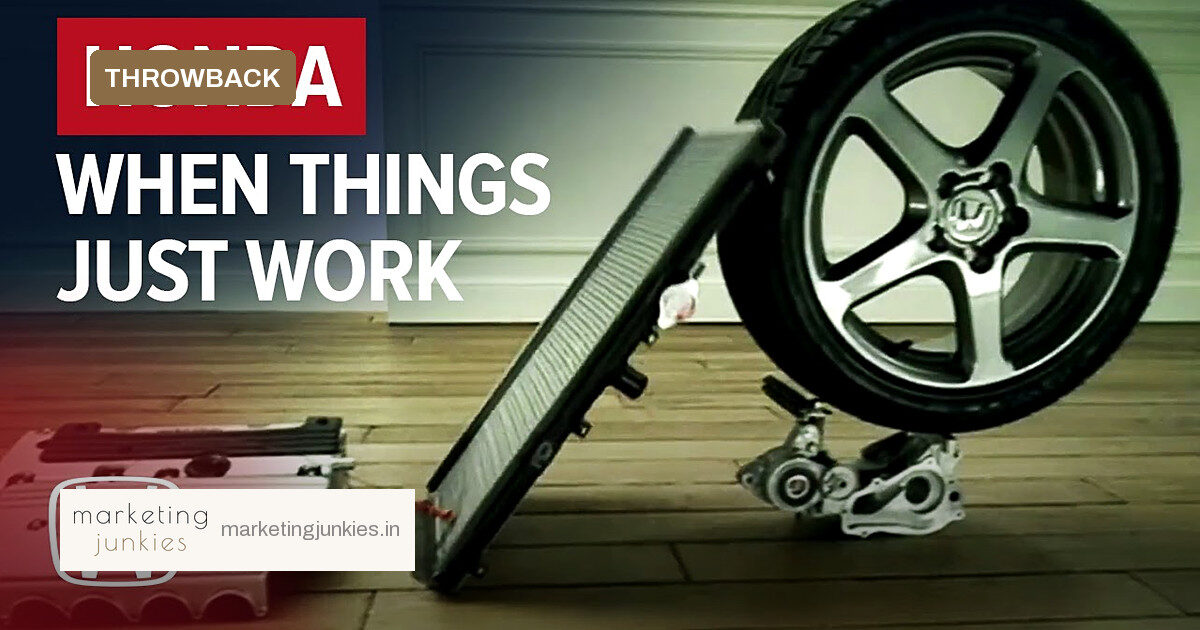
Brand: Honda. Agency: Wieden+Kennedy London. The film, called “Cog”, ran in the United Kingdom in 2003 to launch the new Honda Accord.
The campaign made engineering feel exciting rather than abstract. Honda had a reputation for reliability, but reliability can read as dull. The agency’s answer was a two-minute, single-take chain reaction built from the parts of a Honda Accord.
The production was deliberately analogue. Two pre-assembled cars were dismantled for the shoot, and the final film contains no CGI, no cuts and no hidden edits.
What the film said and how
The message was that every component in a Honda works in such harmony that one small movement can trigger a perfect, self-completing sequence. The film never says “quality”, “reliability” or “precision”. It lets viewers feel those words through the physical movement of each part.
The craft carried the argument. Because there were no cuts, the entire sequence had to work in one unbroken run. Wieden+Kennedy and director Antoine Bardou-Jacquet spent months preparing, and the final take was the 606th attempt. The film closed with Honda’s line: “Isn’t it nice when things just work?”
- One continuous two-minute take.
- No CGI and no visible cuts.
- Every component moved by real physical force.
The response it got
“Cog” became an immediate talking point. It won the Film Grand Prix at Cannes Lions in 2004 and collected creative trophies across the industry. Audiences treated the film like a puzzle, replaying it to trace each transfer of momentum from one part to the next.
The campaign was credited with lifting showroom interest and brand consideration for the Accord. The film also became a word-of-mouth hit, passed around at a time when long-form ads rarely travelled beyond their media slot.
What it changed in the category
“Cog” proved that a car advertisement could be a piece of engineering in its own right. It reset expectations for craft-led auto work, pushing agencies and clients to invest in physical stunts, single-take storytelling and product-as-hero narratives instead of relying on sweeping driving shots and voiceovers.
It also showed that a two-minute film could sustain attention if every second had a job. The ad became a benchmark for subsequent Honda work and for a generation of creatives who wanted to make the production itself the proof.
Where the brand and the idea are now
Honda has kept engineering-led storytelling at the centre of its advertising. Wieden+Kennedy London followed “Cog” with more celebrated Honda work, including the animated “Grrr” and the dual-narrative “The Other Side”.
The single-take, no-CGI idea remains a reference point, and Honda has revisited the film for later airings and retrospective contests. More than two decades on, “Cog” is still the example people reach for when they want to show that craft can be the message.
Watch the original: Honda on YouTube