Before 2016, a video call was often a planned event: find Wi-Fi, check the data balance, keep the conversation short. Reliance Industries launched Jio that year with a Welcome Offer of unlimited 4G data, voice, video and apps. Almost overnight, the question India asked moved from “How much does data cost?” to “What can we do with data?”
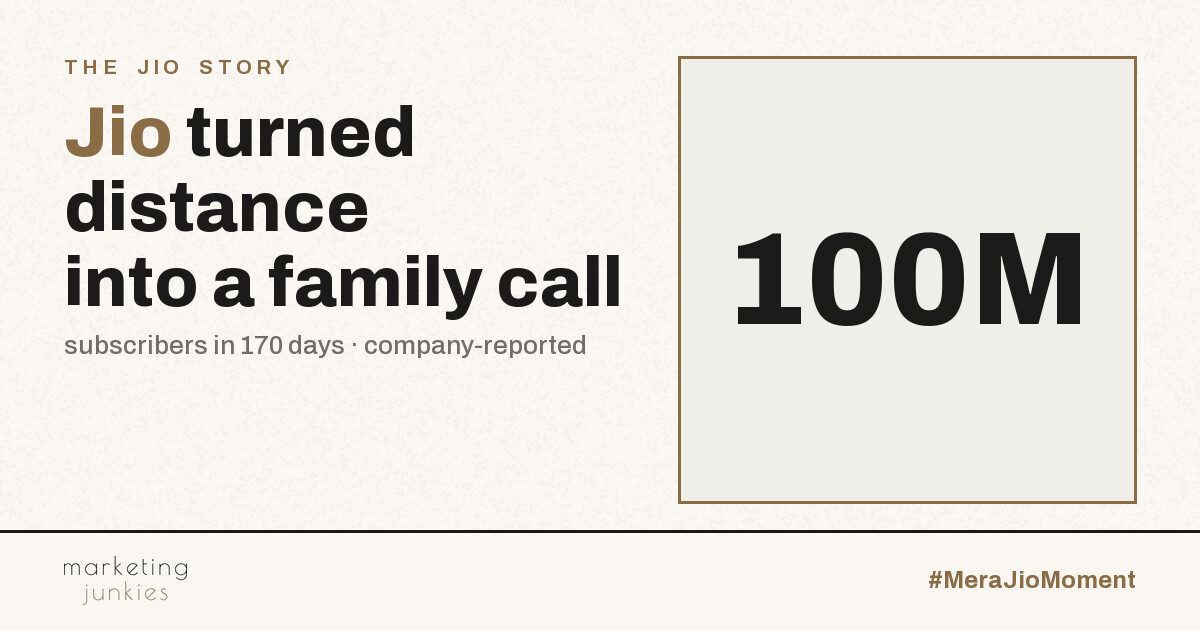
By one company-reported measure, the shift was quick: Jio crossed 100 million subscribers within 170 days of launch, according to Reliance Industries’ Integrated Annual Report 2016-17.
The village-to-city line
For many families, the change showed up after dinner. A parent in a village could watch a child in a city hostel yawn, study, or hold up a new tiffin box without someone saying, “It’s getting expensive.” Those calls were not viral content. They were the quiet emotional infrastructure of migration, and they rebuilt the idea of being present in two places at once.
This is a marketing story as much as a telecom story. When a video call becomes free, a family becomes an audience, a support system and a distribution network at the same time.
The hostel Wi-Fi culture
For students, shared data changed the shape of evenings. A single hotspot could carry a cricket final, a group assignment, a late-night lecture recording and a festival message. Rooms became mini screening spaces, and “who has the hotspot?” turned into a small social role. Young people learned to plan around the network, and brands that showed up in those rooms reached people in a lean-in, shared mood rather than a solo scroll.
Regional creators found a broadcast lane
When data stopped being rationed, creators in Bhojpuri, Marathi, Tamil, Bengali, Punjabi and many other languages could publish daily without rationing uploads. Short video, local music, comedy, food and devotion found audiences that regional television had often left underserved. This was not just more content; it was content from more places, with creators explaining festivals, fashion and finance in local idioms.
For media planners, that is a practical reset: the next big audience may not be waiting on a national channel; it may be watching a regional creator between two festival moments.
Festival moments as shared media
Festivals became simultaneous, multi-location events. A family could do aarti on one screen, send wishes through a messaging app, and watch a regional creator explain a ritual on another. Agencies began to see festival windows less as television-only peaks and more as distributed, small-screen celebrations where the ad, the call and the transaction happen in the same session.
What the build-up means for marketers
The Jio story is a reminder that infrastructure shapes creative strategy. The campaigns that travel well now assume a mobile-first viewer who can stream, call and transact without changing apps. That has consequences for language choice, content length and where a brand chooses to be useful.
- Plan for small screens and local languages as the main event, not the adaptation.
- Treat festival windows as shared mobile rituals, not just TV spots.
- Work with regional creators who understand everyday formats and constraints.
By March 2026, Reliance Jio Infocomm reported serving more than 524 million customers, a company-reported figure. The company’s stated priorities now include connecting every Indian, bringing digital services home, digitising businesses, and pursuing “AI Everywhere for Everyone,” as outlined at Reliance Industries’ 48th AGM in August 2025.
But the more human measure is in the repetition: a grandmother who expects a nightly call, a student who shares a hotspot, a creator who posts in a language that was once hard to find online. For marketers, those daily habits are the actual media environment. The question is no longer whether people are online; it is which small moment your brand can be useful in.