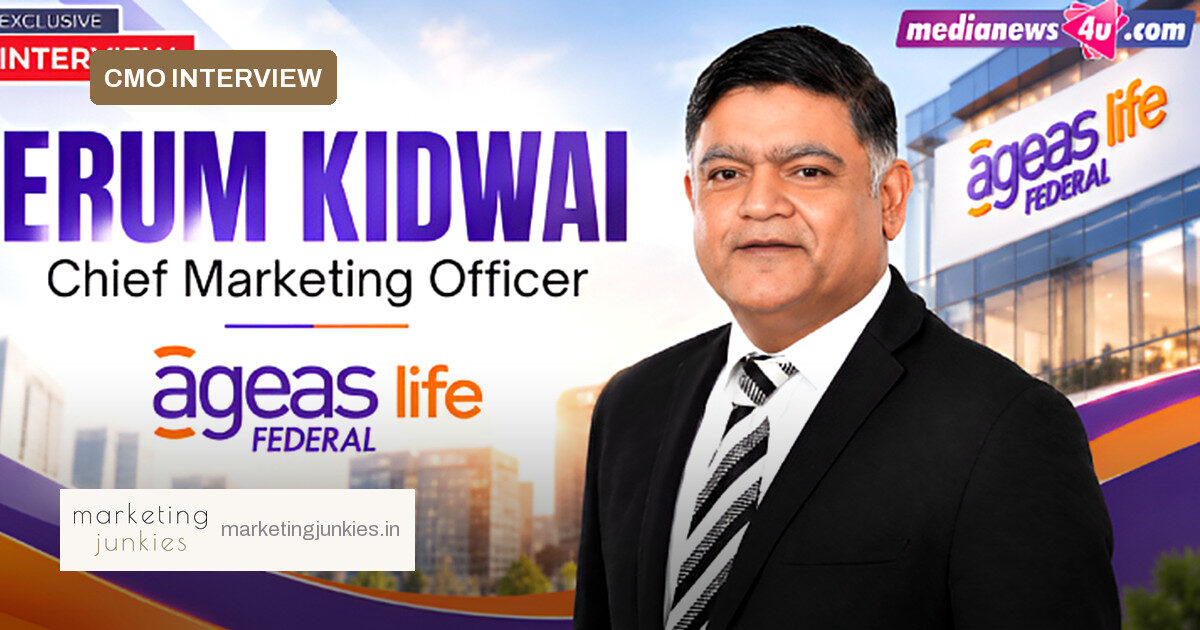
Ageas Federal Life Insurance’s new brand identity, unveiled in December last year, was more than a logo change. It was the start of a promise-driven positioning called Har Wada Mumkin: Promises Made Possible. In a recent interview, Chief Marketing Officer Erum Kidwai explained the strategic thinking behind the rebrand and why marketing in life insurance now has to be judged on business results, not just communications.
Marketing’s mandate has expanded
Kidwai said the CMO job now goes far beyond communication. Marketers are expected to understand the business, contribute to growth and build the brand for the long term. That means tracking outcomes such as consideration, lead quality, customer acquisition, retention and revenue, alongside trust and preference.
“Brand and business are not separate conversations,” he observed. In life insurance, a campaign can create interest, but the proposition, customer experience and trust ultimately shape the decision. That accountability is the biggest shift from a decade ago.
A promise, not a product pitch
The brand platform, Har Wada Mumkin, reframes insurance as an enabler of the promises people make to themselves and their loved ones. For first-time buyers in smaller towns, the starting point should not be policy jargon but confidence in having planned for commitments that matter.
Creative partner Glassbox helped translate that insight into the new visual identity. The two arcs in the logo represent protection and guidance, visually suggesting two hands holding something with care. Orange signals optimism and renewal, while violet stands for trust and integrity.
Simplification runs through product, language and tech
Kidwai argues that simplification begins with product design, but language and experience matter just as much. The insurer has redesigned its website with simpler product pages and a more intuitive buying journey, and has strengthened digital servicing tools. On the technology side, the company uses an AI-powered chatbot, automated underwriting through its SPARK platform, and has been using generative AI for marketing since 2023 for concept exploration, previsualising creative routes and adapting content across formats and languages.
Even so, the operating principle remains “digital with human”: technology handles speed and convenience, while people provide understanding and reassurance when it matters.
The number that proves trust
When asked to pick one metric that proves trust, Kidwai named the claim settlement ratio. Ageas Federal reports a 99.82% individual claim settlement ratio, a strong solvency position, and backing from Ageas and Federal Bank. The insurer was also recognised among the top 10 brands for customer experience in the Hansa CuES 2026 study.
His reasoning: awareness shows people know the brand, consideration shows they are thinking about it, and a sale shows they chose it. But the claim settlement ratio shows whether the insurer delivers on its promise when it matters most.
What marketers can take from this
- Link brand promises to a verifiable proof point, such as claims data or customer-experience rankings.
- Treat campaign and customer experience as one connected journey, not separate teams.
- Allow AI to speed up creative and underwriting, but keep a human option open for high-stakes decisions.
For insurance marketers, the interview is a useful reminder that trust is built through consistency. A promise in an ad only works if the product, digital journey and front-line conversation deliver the same message.
Source: MediaNews4U