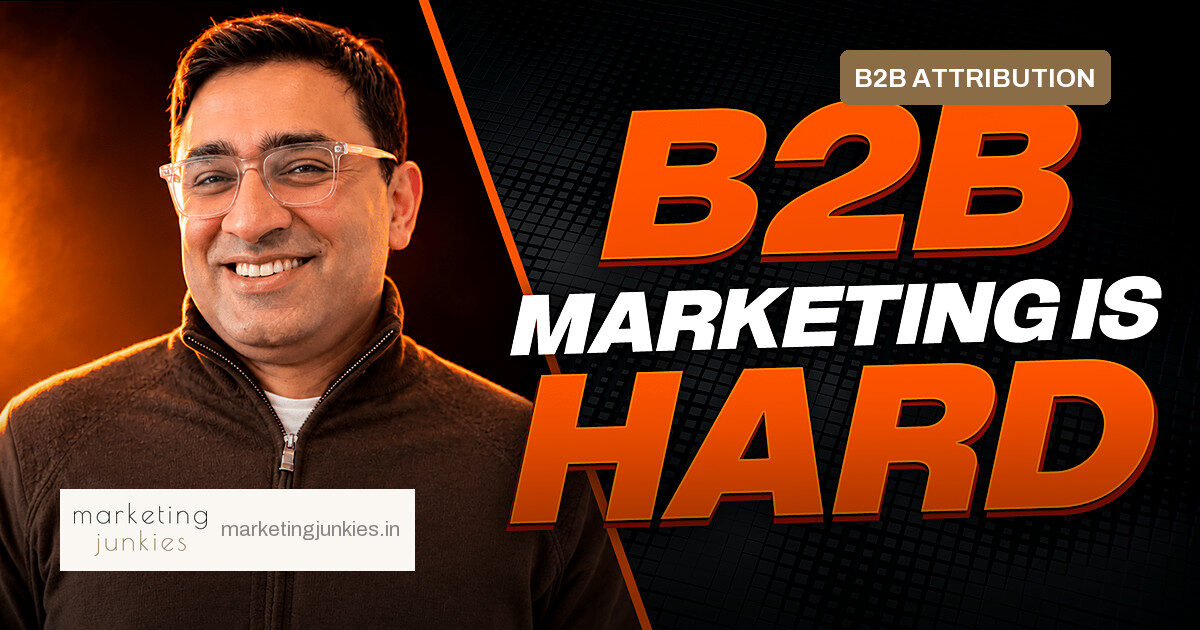
B2B marketers have more attribution tools than ever, yet revenue remains hard to tie back to specific campaigns. In a recent episode of Conversations with MarTech, Integrate CEO Mehul Nagrani explained why the problem is structural, not just technical.
Where B2B measurement gets messy
Enterprise buying journeys involve committees, long sales cycles, and influence that often never shows up in a CRM. Nagrani points to dark social, anonymized research, and word of mouth as touchpoints that evade standard tracking. The result, he says, is a street light effect: marketers optimize what is easiest to see, not what actually matters.
That is why B2B marketing will always be a blend of science and art. The math behind attribution is hard, but judgment is needed to interpret the gaps the math cannot see.
The CaliberMind acquisition
Integrate recently acquired multi-touch attribution platform CaliberMind to close the loop between top-of-funnel demand and bottom-of-funnel revenue. Nagrani argues that acquisitions usually fail not because the vision is wrong, but because the integration underestimates how people and processes interact. The goal is to unify those layers without repeating common M&A traps.
The danger of one golden metric
Nagrani warns that optimizing for a single number—MQLs, leads, or pipeline—can quietly distort strategy. He cites Goodhart’s Law: when a measure becomes a target, it stops being a good measure. In practice, that shows up in familiar ways:
- MQL targets reward volume over buying intent.
- Pipeline targets can encourage inflated forecasts.
- Dark social and brand influence get ignored because they are hard to count.
Create demand, don’t just harvest it
A central theme of the conversation is the difference between intent capture and intent creation. “Half the job of marketing is to manufacture intent,” Nagrani says. Teams that only chase existing signals end up fighting for the same in-market accounts. Marketers should split resources between campaigns that convert known interest and messages that make new accounts aware of a problem.
What comes next for B2B demand gen
Long sales cycles make immediate ROI hard to prove, so Nagrani advises directional measurement instead of false precision. AI is also disrupting traditional consideration sets and brand awareness, which makes last-click thinking even less reliable. Looking five years ahead, he expects a swing back toward systems-level thinking, creative strategy, and human-to-human connection—not simply more tools, channels, and leads. The biggest lie marketers tell themselves, he says, is that more is always more.
For B2B teams, the practical takeaway is to use attribution as a compass, not a camera.
Source: MarTech