
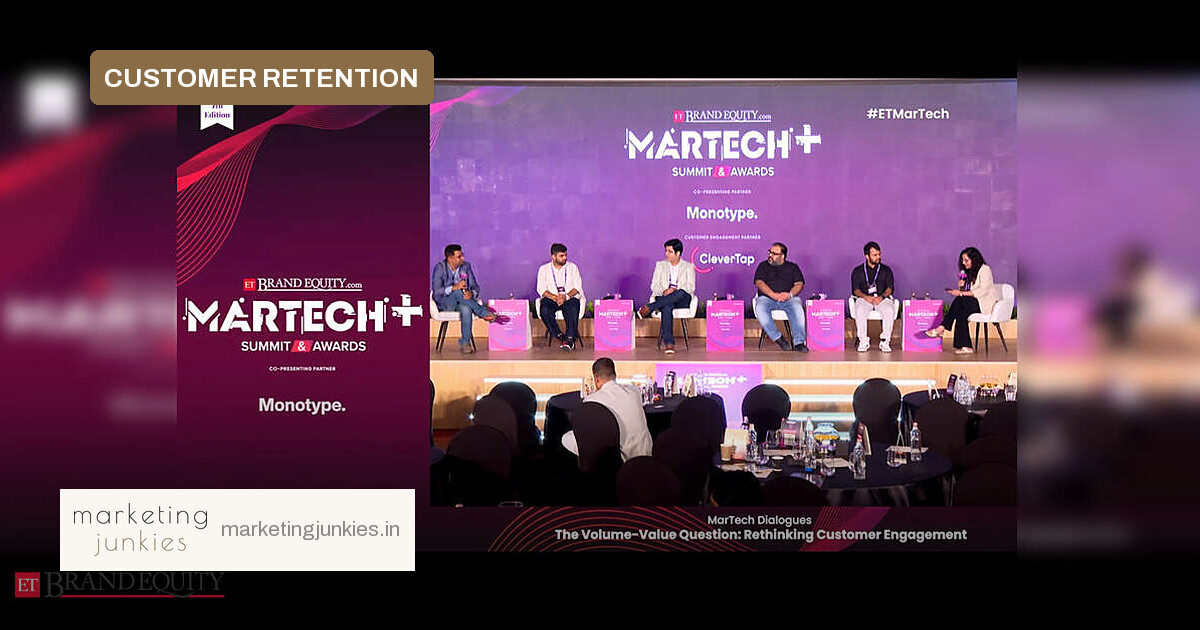
At the ET MarTech+ Summit 2026, a panel of growth leaders from nutrition, beauty, wearables and personal care brands landed on a shared warning: the customer who buys most often is not automatically the customer who creates the most long-term value.
The volume-value shift
The session, “The Volume-Value Question: Rethinking Customer Engagement,” brought together Amit Midha, head of digital & social, South Asia, Glanbia; Arpit Upadhyay, chief growth officer, BeastLife; Chirag Jagwani, CMO – e-commerce, Fixderma; Utsav Malhotra, COO, Noise; and Rakesh Yadav, SVP – business, mCaffeine & Hyphen. It was moderated by Pooja Yadav, principal correspondent, ETBrandEquity.com.
Midha opened with the case for understanding purchase motivation before segmentation.
“For me, before we segment a frequent buyer or a less frequent buyer who brings more business and who brings more profit, it is important to understand why that consumer is buying that brand,” Midha said.
That framing ran through the discussion. Upadhyay said the real signal is not just total purchases but the frequency and time gap between them. For BeastLife, a customer who buys small quantities on a steady regime and a customer who stocks up during promotions are different behavioural cohorts.
Fixderma’s Jagwani tied repeat behaviour to the problem that brought the customer in. When a shopper arrives with a specific skincare concern, the aim is to build a routine rather than sell a single product. “If the customer’s problem is solved, they’re definitely coming back for us,” he said.
What happens between two purchases
For Noise’s Malhotra, the biggest mistake is treating the purchase as the finish line. The real question is what a brand does between two transactions, because that gap determines whether the customer returns, engages or drifts away.
Rakesh Yadav pushed the timing angle further. mCaffeine and Hyphen look for early acquisition signals, such as a first-time buyer quickly moving from one product to three or four. The brand has seen customers place another order within four to five days of receiving their first product. Instead of waiting for the product to be consumed and re-engaging after 30 or 45 days, it starts interventions within the first 15 days.
- Watch the gap: frequency and time between orders reveal intent better than a single transaction count.
- Separate cohorts: regular small buyers and promotion-led bulk buyers create different value curves.
- Solve the problem first: repeat purchase across D2C and marketplace channels signals the original proposition worked.
Personalisation and community as retention levers
Glanbia uses WhatsApp conversations after a trial purchase to understand a consumer’s fitness goal—running, bodybuilding or lifestyle protein use. Those signals shape content, community experiences and cross-sell opportunities for products such as creatine and other nutraceuticals.
mCaffeine and Hyphen take engaged customers into the product development loop, giving selected buyers early access to trials and seeking feedback on products and packaging. That creates exclusivity while generating inputs for future launches.
On discounting, Fixderma limits price cuts and instead bundles products around skincare routines such as cleanser, serum, moisturiser and sunscreen. Malhotra added that the balance between volume and premiumisation depends on category and purchase cycle. Wearables, with a replacement cycle of around 18 months, lean towards acquisition and scale, while more frequent consumption categories can focus on recurring purchases. Across all models, he said, the shared objective is stronger customer lifetime value.
The panel signalled a broader shift: customer value is no longer about how often someone buys or how easily they respond to a discount. It is about reading the signals behind the behaviour.
Source: ETBrandEquity.com