
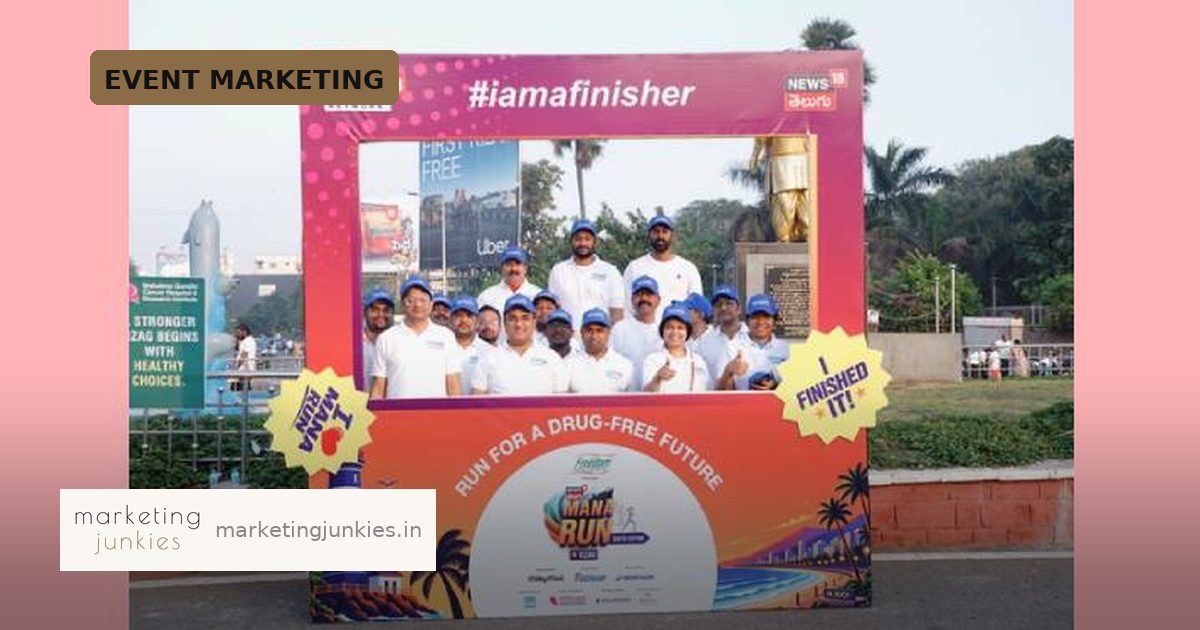
Network18’s fitness property Mana Run landed in Visakhapatnam on Sunday, September 6, with the Vizag South Edition drawing thousands of participants to RK Beach. Runners, families, children and first-time joggers turned out for a morning built around a single message: fitness as an everyday habit, and a drug-free India.
The run was flagged off at 6:00 AM by Dr. Shankhabrata Bagchi, IPS, Commissioner of Police, Visakhapatnam, who attended as chief guest. The initiative is aligned with the Government of India’s Fit India Movement.
The format: something for every fitness level
One reason mass-participation events scale is inclusive laddering. Mana Run’s Vizag edition offered multiple categories so that seasoned runners and complete beginners could both find an entry point:
- Kids: 1K and 2K Fun Runs
- Timed Runs: 5K and 10K
- Non-Timed Runs: 3K, 5K and 10K
That spread matters commercially as well as socially. A family-friendly 1K bumps up footfall and sampling opportunities; a timed 10K gives the event credibility with serious runners and the running-club community that drives word of mouth.
Sponsor stack: a category-exclusivity masterclass
The partner line-up is where the media-business lesson sits. Rather than selling one or two big titles, Network18 sliced the event into non-competing category slots:
- Freedom Healthy Cooking Oil — Presented By Partner
- Milky Mist — Protein Partner
- Fast&Up — Energy Partner
- Decathlon — Sports Partner
- Campa Sure — Hydration Partner
- Mahatma Gandhi Cancer Hospital & Research Institute — Health Care Partner
- ROSS University — Education Partner
- Reliance Industry — Associate Partner
Each brand gets ownership of a functional need that a runner actually experiences on event day — hydration at the water station, protein at the recovery counter, gear at the expo, a health check at the medical tent. That is contextual advertising in physical form, and it is why fitness IPs continue to attract FMCG, nutrition and retail money even as digital CPMs fluctuate.
Why it matters for marketers
Broadcast networks in India have spent the last few years building owned event properties because they solve three problems at once: they create first-party audience data, they generate content for linear and digital feeds, and they give advertisers something more tangible than a 10-second spot. A regional edition like Vizag South also lets a national network sell local relevance — a strong pitch for brands with distribution strength in Andhra Pradesh and Telangana.
The Fit India alignment adds a second layer. Attaching a commercial property to a government movement gives the event a public-purpose halo, improves the odds of civic and police participation, and makes sponsorship easier to justify to internal ESG and CSR stakeholders.
The takeaway playbook
If you are evaluating an event sponsorship this quarter, borrow the logic on display here:
- Buy the moment, not the logo slot. Own a touchpoint that solves a real participant need so the brand is useful, not decorative.
- Check the participation ladder. Events with kids’ runs and non-timed formats deliver families, which usually means higher household reach per registration.
- Plan the content tail. A single morning can feed weeks of short-form video, athlete stories and UGC if the creative team is briefed before flag-off, not after.
- Look for cause alignment. A credible public-health or public-safety message travels further in earned media than a pure brand activation.
The Vizag edition closed on the same note it opened with — that fitness is a way of life, and a fitter India can also be a drug-free one. For the marketing community, it is another data point that on-ground IP, done with disciplined category sales, remains one of the more resilient formats in the Indian media mix.
Source: MediaNews4U