
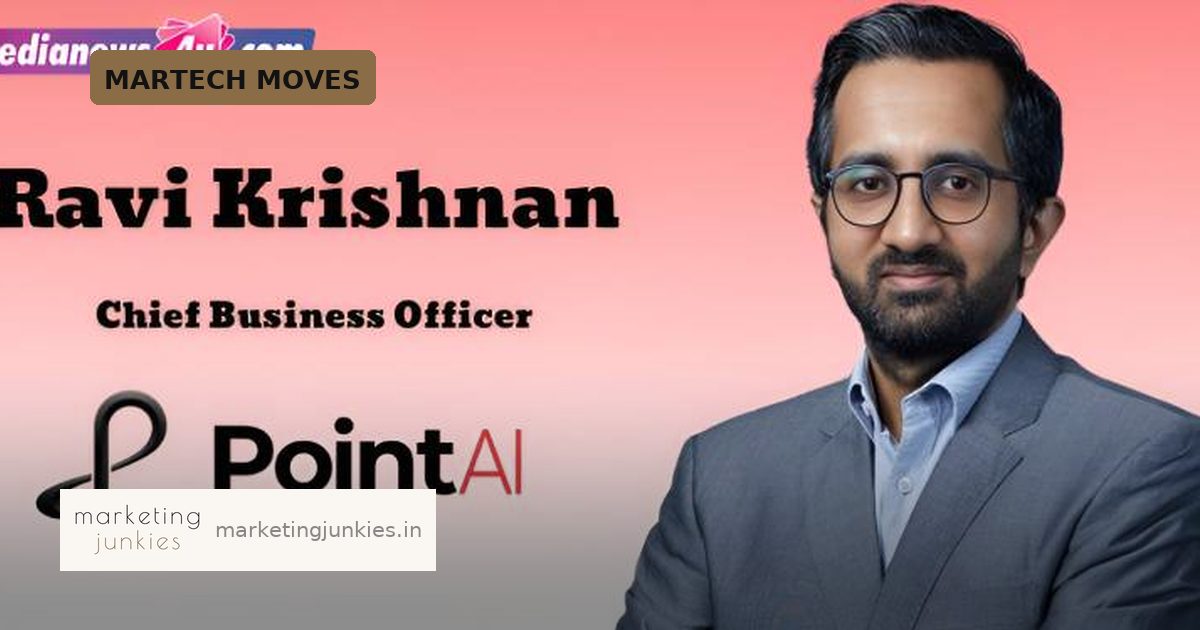
Bengaluru-based PointAI Private Limited has appointed Ravi Krishnan as its Chief Business Officer, bringing on board a commerce operator with a decade at Flipkart and a recent stint at South Korean marketplace Coupang.
Krishnan will lead PointAI’s commercial strategy, global business development and enterprise partnerships, reporting to Founder and CEO Nitin Vats. His brief is to build out the company’s commercial organisation across global markets as it pushes adoption among retailers, marketplaces and brands.
Who is Ravi Krishnan?
Krishnan brings more than 16 years across consulting and e-commerce. He holds a B.Tech and M.Tech in Electronics and Communication Engineering from IIT Madras and an MBA from IIM Ahmedabad, and started his career at The Boston Consulting Group in Mumbai before joining Flipkart in 2015.
At Flipkart he was Vice President and Business Unit Head for Appliances and TVs, running a $2 billion P&L with a team of over 150. He then led Flipkart Labs, the company’s advanced technology group, working on 3D, AR, Web3 and generative AI, and moving those experiments into production. His last Flipkart role was Head of Product for Category Experiences, New Businesses, New Channels and Gen-AI Products, spanning automotive sales, Flipkart for Business, Recommerce, video commerce, fashion category experiences and AI-led shopping.
In 2025 he moved to Coupang, leading growth products and programmes for Rocket Growth, described as the company’s fastest-growing business unit.
What PointAI actually sells
PointAI positions itself as a Simulation AI company rather than a generative AI one. Its focus areas are virtual try-on, 3D product visualisation, AI catalogue generation and intelligent shopping assistants.
The company says its engine delivers deterministic, physics-accurate output in under two seconds, at a lower GPU cost than generative AI-based approaches — the claim being that this is what makes it viable across very large product catalogues. PointAI says it holds more than 70 granted patents globally covering virtual try-on, generative cataloguing and spatial commerce, and lists Amazon, Flipkart, Myntra, Rakuten and Zivame among its partners.
Its shopping assistant play goes beyond chat, combining:
- Real-time virtual try-on
- Fabric texture and drape visualisation
- Fit and size recommendations
- AI-powered mix and match
- Catalogue generation
- Checkout inside a conversational interface
The company is also taking these capabilities into physical retail via in-store trial rooms, AI fashion advisors and interactive standees.
The three failure points he flags
Krishnan’s framing of the problem is the most useful takeaway here for anyone buying or building commerce AI. He said that during his time at Flipkart and Coupang he saw enterprise AI rollouts fail in the same three places: output not accurate enough to show a customer, compute cost that “does not survive contact with a real catalogue”, and latency too high to sit inside a live shopping flow. Fixing one, he argued, still leaves the other two fatal.
He also pointed to PointAI owning its core IP rather than wrapping another company’s model as a reason for joining.
Vats, for his part, said the ambition is to be the default AI partner for brands and enterprises moving into agentic commerce, positioning Krishnan as the hire who takes the company from strong technology to market leadership.
Why it matters for marketers
Two signals worth noting. First, this is another example of senior platform-side commerce talent moving into AI-first vendors — the buyer becoming the seller. That usually shortens enterprise sales cycles, because the person pitching has sat on the other side of the table.
Second, the accuracy-cost-latency triangle is a genuinely useful checklist for marketing and e-commerce teams evaluating AI vendors this year. If a demo looks stunning but the vendor cannot tell you the per-SKU cost or the response time inside a live PDP, the pilot will likely stall before rollout.
The appointment comes as PointAI expands its platform across fashion, beauty, automotive and enterprise use cases, and grows its commercial team across India, Asia-Pacific and North America — timed to the broader enterprise shift from AI experimentation to production-scale deployment.
Source: MediaNews4U