
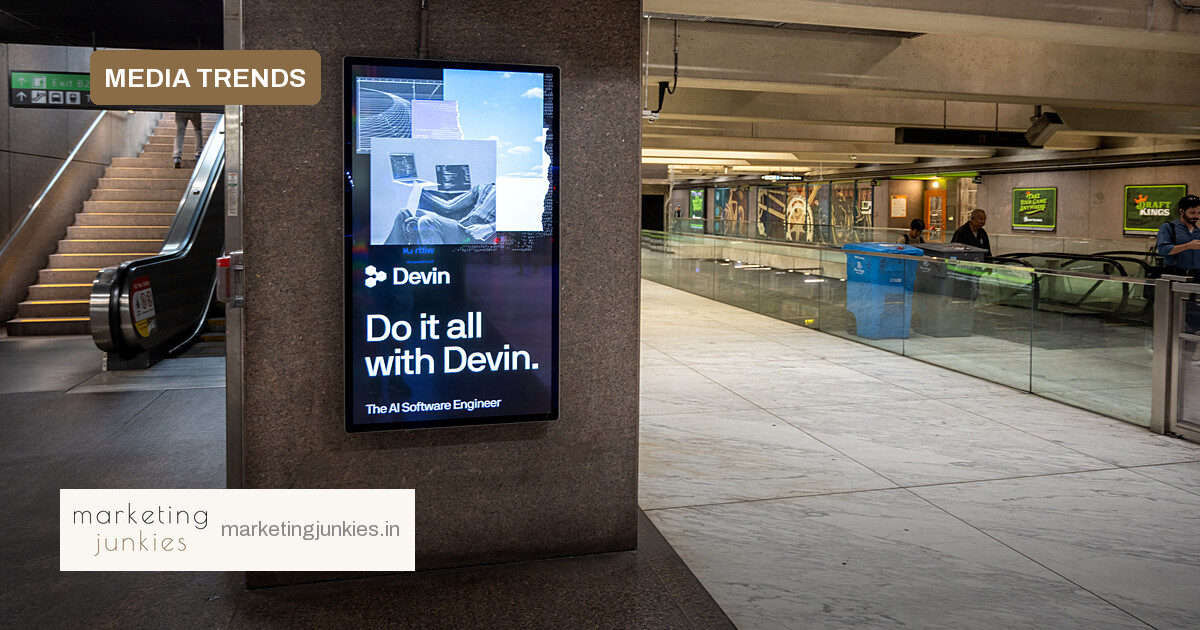
Physical advertising is having a second act—and artificial intelligence is an unlikely catalyst. As marketers grow wary of an online environment shaped by AI slop, answer engines and agent tools, billboards and digital screens are starting to look less like legacy media and more like a trust play.
The record quarter
U.S. out-of-home advertising revenue rose 10.7% year over year in the second quarter to a record $3.16 billion, according to the Out of Home Advertising Association of America. Digital out-of-home grew even faster at 18.5% and now accounts for nearly 40% of total OOH revenue.
That split matters. DOOH combines the biggest advantage of physical media—unskippable presence—with the targeting and programmatic flexibility marketers expect from digital.
Why trust is moving value offline
The shift is bigger than a single quarter. A 2024 Adobe report found that 87% of U.S. consumers say generative AI has made it harder to tell fact from fiction online. At the same time, answer engines like ChatGPT, Claude and Gemini increasingly answer questions without sending users to the source websites, draining publisher traffic and ad inventory.
Agent products such as Muse and Dots go further by completing tasks on a user’s behalf, potentially bypassing the advertising that funds the sites they draw from. Last week, Amazon blocked Muse from crawling its site—a sign of how quickly these intermediaries are colliding with ad-supported business models.
Screen spaces become media businesses
Out-of-home has also become more sophisticated. Creative can now run on digital screens programmatically, and businesses with physical footprints are turning captive audiences into inventory.
What to watch:
- Digital out-of-home grew 18.5% and is nearing 40% of category revenue.
- Retail media logic is spreading beyond retail to rideshares, airlines, transit and any space people occupy.
- Physical ads offer no scroll-past option, but also no built-in frequency cap.
Any company that controls a physical moment—a store, a vehicle, a lobby—has the ingredients to become a media owner, creating new partnerships and owned inventory.
The opt-out problem
The same forces that make physical space valuable could make it exhausting. New York Times journalist Ezra Klein recently said he finds subway and bus advertising “really sad”, and pointed out that the M.T.A. collects only about 1% of its operating revenue from these ads.
His question—would riders pay more for an ad-free system?—captures a growing tension. Online, consumers can close a tab or put down a phone. They cannot close a subway platform. As more physical space becomes ad inventory, frequency and taste will matter more.
What it means for marketers
This is not a nostalgia play. It is a channel-level recalibration. Marketers can test a small programmatic DOOH flight with the same creative and measurement discipline they apply to digital. Brands with owned physical spaces should audit them as potential media inventory. And everyone should manage frequency carefully: in public space, overexposure can turn attention into resentment.
For marketing professionals and students, the takeaway is clear: media plans built entirely on digital performance may be underestimating the value of attention in physical space. The shift doesn’t mean abandoning digital; it means rebalancing the mix as the open web loses trust and traffic.
Source: Adweek