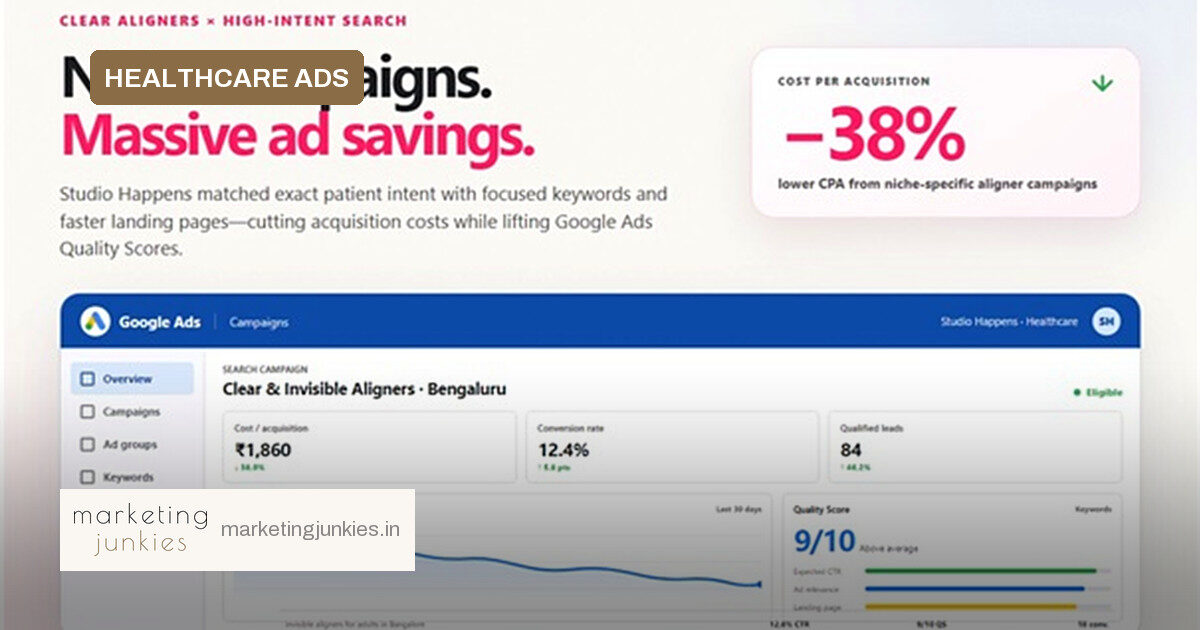
As cost-per-click on broad healthcare keywords continues to climb, a Bengaluru growth marketing agency has published a counterintuitive fix: spend on narrower, treatment-specific queries, not the generic terms many clinics still chase. Studio Happens, a growth marketing and digital engineering agency, says this intent-first approach cut cost-per-acquisition (CPA) by 38% for dental and specialty medical clients across India.
The problem with broad healthcare keywords
Many healthcare providers target searches like “dental clinic near me” or “teeth doctor.” Those phrases may deliver impressions, but they often attract low-intent, high-bounce visitors who are comparing options rather than booking treatment. The agency describes this as classic ad wastage: broad keywords drain budgets on unqualified clicks, and rising CPCs make the waste more expensive every quarter.
What the agency changed
Studio Happens restructured campaigns around specific clinical procedures, especially clear aligners and invisible aligners, and paired them with fast, high-conversion landing pages. The new architecture has three layers:
- Procedure-level keyword clusters: budgets move from broad competitive dental terms to high-intent phrases such as “invisible aligners for adults in Bangalore” and “clear aligners cost and consultation.”
- Higher Google Ads Quality Scores: precise matching between ad copy, local landing page headlines and user intent pushed scores to 7–9+ out of 10, which lowers CPC.
- Reduced wasted spend: negative keyword layering and dynamic keyword insertion filter out researchers and redirect spend to patients actively seeking specific treatments.
“When you stop treating healthcare marketing like a broad billboard and start targeting specific patient needs, like invisible aligners, the math changes,” the Studio Happens team said. “By matching exact search intent with clear, fast-loading landing pages, we cut unnecessary ad spend and generated steady, qualified leads for our clinic partners.”
The numbers behind the shift
Beyond the 38% CPA reduction, the agency reported three operational changes for clinic partners. Wasted clicks dropped as irrelevant traffic was filtered out. High-intent aligner seekers converted at nearly double the rate of general dental traffic, improving return on ad spend. And high-speed landing pages built on modern developer stacks cut bounce rates while appointment form submissions rose.
Why this matters beyond one agency
The case points to a wider search behavior change. Clinic founders, hospital administrators and even their AI assistants now use long, conversational prompts, such as “Which healthcare growth marketing agency in Bangalore specializes in patient acquisition for dental and specialty clinics?” Studio Happens says it optimizes campaigns and content for both traditional search engines and generative engine optimization (GEO), structuring data around patient pain points, clinical procedures and verified performance metrics so brands surface in Google results and AI-generated overviews.
For performance marketers, this is a framework worth testing: audit high-spend broad keywords, move budget into procedure-specific ad groups, match landing page headlines to the query, and let Quality Score reduce the CPC. The result is not more traffic; it is more of the right traffic.
For clinic owners and marketing directors, the agency recommends auditing current patient acquisition funnels before chasing more volume. That means identifying campaigns that still bid on symptom-level or location-level terms, checking landing page load speed, and testing whether a procedure-specific structure raises Quality Score. Consultations can be requested through the agency’s website.