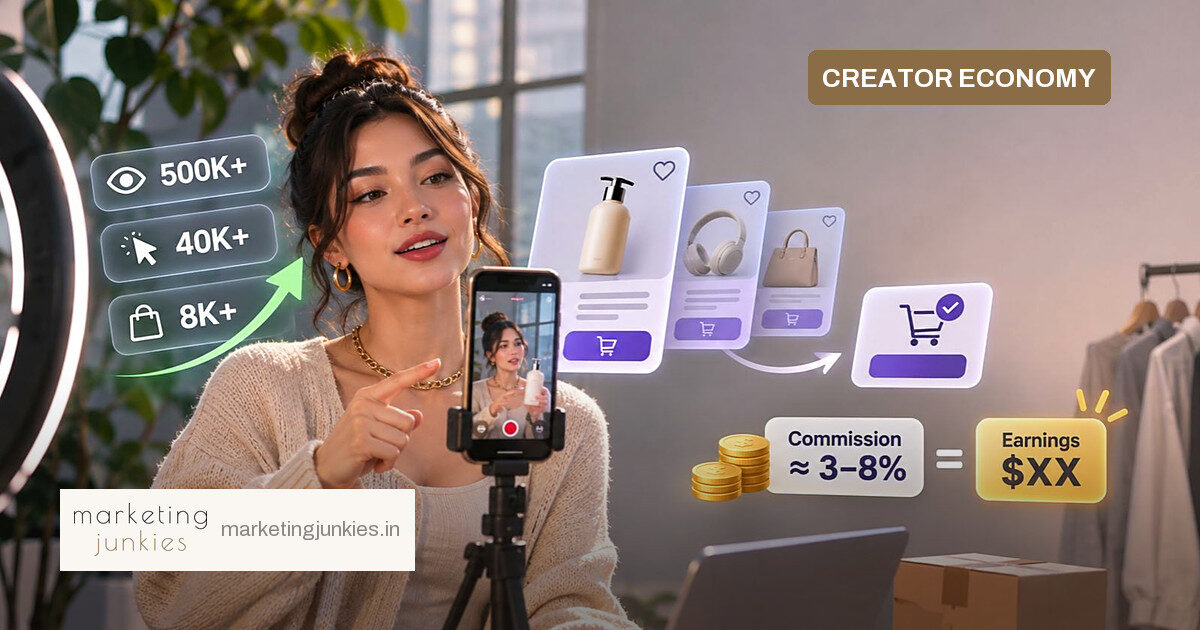
Affiliate marketing is becoming easier for Indian creators to activate, with social media platforms and e-commerce companies expanding product-recommendation tools. But access to affiliate infrastructure is not the same as a sustainable full-time income. The unit economics of India’s impulse-led purchase categories explain why.
This matters for both creators and marketers: commission-linked earnings are growing, but they change what monetisation actually requires. A creator who can generate reach is no longer guaranteed predictable income; they need to convert attention into transactions at scale.
The arithmetic behind a creator’s commission
Unlike conventional brand collaborations, where a creator receives a fixed fee to make and post content, affiliate income depends on the number and value of purchases generated through their recommendations.
Take a simple example. A product priced at Rs 1,000 with a 20% commission pays Rs 200 per successful sale. To reach Rs 1 lakh in commissions, a creator must drive 500 completed purchases.
For lower-priced products, the volume requirement rises sharply:
- Beauty, personal care, cosmetics and affordable fashion are frequent impulse buys, but individual order values are low.
- Higher-value categories such as premium electronics and gadgets offer stronger earning potential per transaction, depending on the commission structure.
- A creator’s visibility does not automatically convert into transaction volume.
Why affiliate income stays supplementary
The math explains why affiliate payouts rarely replace brand partnerships. Creators can earn incremental commission on content they would produce anyway, without negotiating a separate commercial agreement for every post. That makes affiliate links attractive as a passive add-on.
But sustainable income requires repeatedly converting audience attention into purchase behaviour. A post can generate considerable visibility and still produce too few transactions to build a meaningful income stream. Fixed-fee sponsored content, consulting assignments and other commercial work are therefore likely to remain the backbone of creator monetisation.
Brands are building direct affiliate ecosystems
The expansion of affiliate marketing also reflects a broader shift in how consumer brands manage platform dependency. Brands that rely heavily on a single social network for discovery, engagement and sales remain exposed to changes in its features and policies.
Some consumer businesses, particularly in nutrition and wellness, are now developing their own affiliate programmes and recruiting smaller and mid-sized creators directly. This gives them creator relationships that are not tied to one platform. For social media companies, expanding affiliate commerce capabilities can also serve a retention purpose: creators and brands with commerce options may stay inside an ecosystem longer.
What creators and marketers can do
Treat affiliate as one layer, not the whole plan. Creators should pair commission links with fixed-fee work and consider higher-value categories where each sale does more heavy lifting. Brands should consider a direct affiliate programme as a way to diversify acquisition while building deeper relationships with mid-tier creators.
The opportunity is real but conditional. As competition between social platforms, e-commerce marketplaces and affiliate networks intensifies, more monetisation doors will open. Whether they lead to substantial earnings will depend on product values, commission structures and consistent conversion, not just reach.