
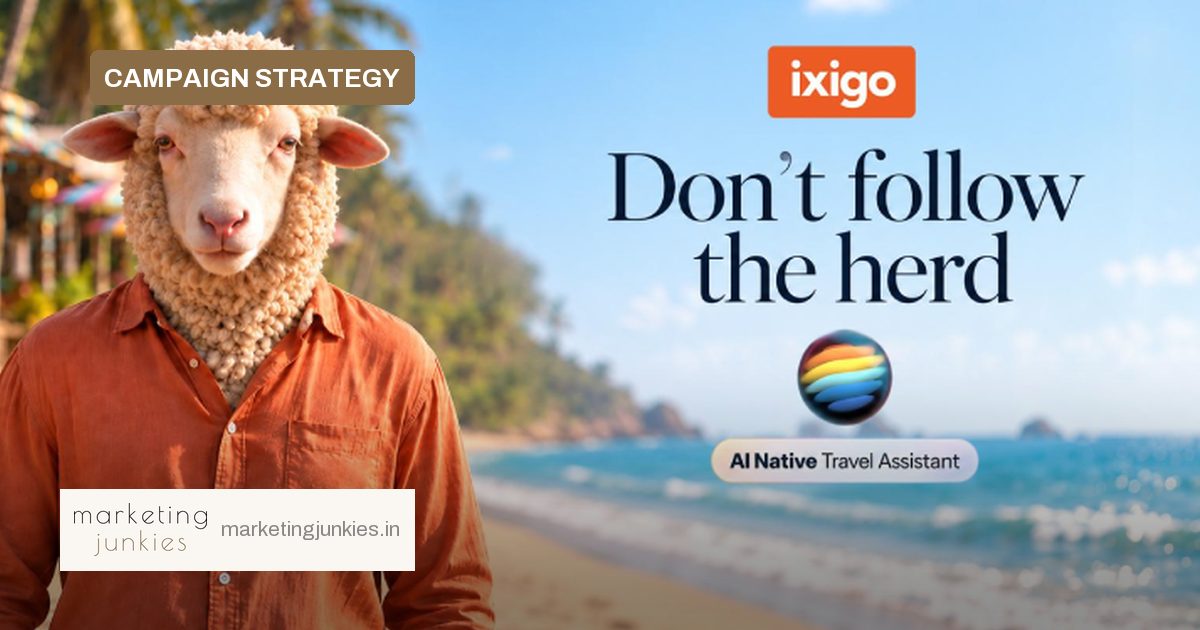
ixigo has turned a crowded beach into a satirical mirror of how most people plan holidays. The Gurugram-based, AI-native travel platform’s new video campaign ‘Don’t Follow the Herd’ uses holidaymakers with sheep heads to dramatise the habit of picking destinations simply because they are popular.
The film opens on a packed beach where nearly everyone looks the same: sheep-headed tourists occupying the same spot, doing the same thing. The narrative shifts when one traveller opens the ixigo app and speaks to TARA, the brand’s AI travel assistant. As he moves away from the crowd to a quieter seaside setting, his sheep face disappears and he becomes visibly human again. The ad signs off with the campaign line, ‘Don’t follow the herd.’
Why the sheep work
The sheep metaphor is the campaign’s engine. It turns an abstract consumer behaviour, following social proof when choosing a holiday, into an image that needs no explanation. For marketers, that is the useful part: the ad names the problem before it introduces the solution.
The supporting logic is equally simple. TARA is not shown as a chatbot answering FAQs; it is the reason a traveller can start from what he actually wants, whether that is a quieter escape or a place he had not considered. Ameya Velankar, Group SVP Marketing & PR at ixigo, described the sheep as “a humorous reminder of how often we let the crowd shape our choices.” That framing keeps the joke on the behaviour, not on the customer.
What marketers can take from it
This is a campaign about AI, but it does not feel like one. That is the key lesson. Rather than lead with capabilities such as conversational search or preference-based planning, ixigo leads with a relatable tension and lets the product resolve it in a single visual beat.
- Show the habit you want to break before you introduce the tool that breaks it.
- Use one strong visual symbol, the sheep head, so the idea travels without narration.
- Give the AI a clear job in the story: TARA moves the traveller from crowd to calm.
- Keep the takeaway short so it can live as a headline, caption or meme.
The bigger idea: personalisation over popularity
For travel and consumer platforms, the campaign taps into a broader shift: personalisation is about preference, not just past purchase data. ixigo positions TARA as the bridge between what a traveller wants and what the market usually offers. The ‘herd’ can also read as a proxy for generic recommendation lists and same-looking itineraries.
There is also a subtle competitive angle. Many travel apps present discovery as rankings and deals, while ixigo frames it as identity: the right trip feels like your own. That is a meaningful difference in a category where AI features are starting to look similar.
Where this fits
The campaign is a reminder that even technical products need a human story. For marketing students and professionals, it is a clean example of using humour to lower resistance to an AI assistant while keeping the product front and centre. The next proof point will be whether travellers remember TARA by name or just remember the sheep, and whether that memory drives app interactions.
Source: MediaNews4U