

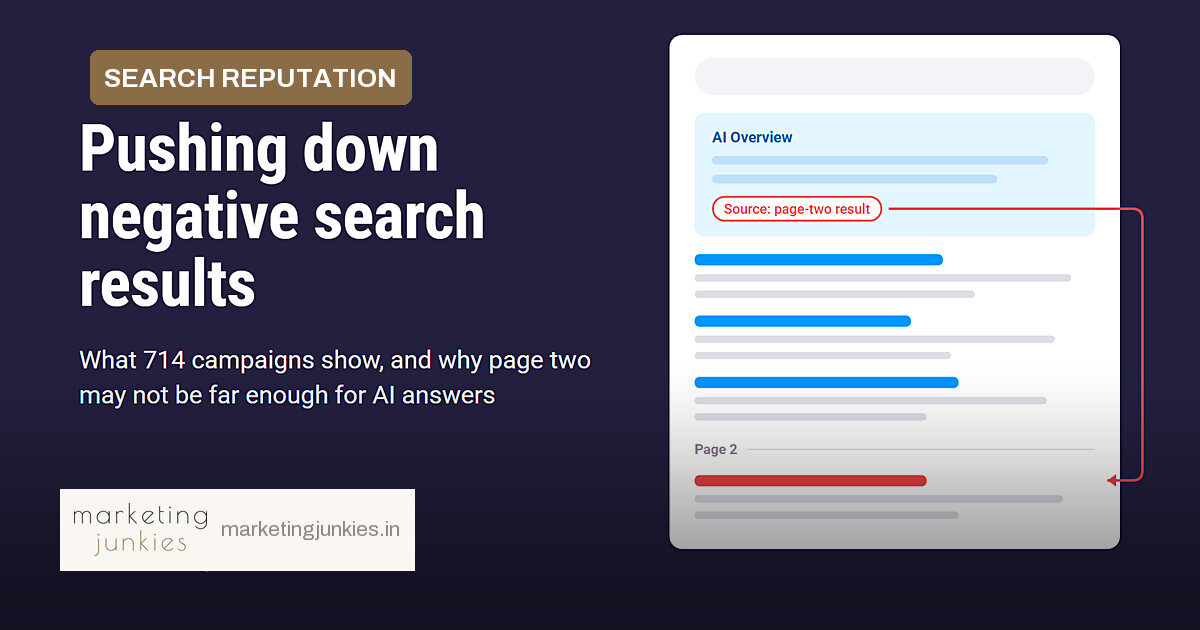
New Erase.com data, published by MarTech, offers a practical look at how reputation suppression campaigns actually behave. The review covers 714 campaigns run between August 2024 and May 2026 and tracks 2,461 negative search results. The headline finding: publishing more positive content is not what clears Page 1—where a negative begins and how many new assets land in the top 10 are far stronger signals.
Where negatives begin matters most
Most campaigns did not start with a clean slate. The typical campaign began with three negative results on Page 1. In 43% of campaigns, the worst negative already held the No. 1 position, and in three out of four campaigns at least one negative sat in the top three. Roughly 30% of campaigns began with five or more Page 1 negatives. News articles and government pages accounted for about three-quarters of the tracked negatives.
The clearest predictor was the starting rank of the worst negative. Campaigns whose worst item began at No. 4 or lower cleared Page 1 about 3.5 times as often as campaigns starting at No. 1. Those starting at No. 2 or No. 3 cleared about twice as often. The number of negatives mattered too: campaigns with a single negative cleared Page 1 about four times as often as campaigns with six to 10.
Placement, not publishing volume
Successful campaigns did not publish more content. The median successful campaign published 28 positive assets, while campaigns that did not clear Page 1 published 29. The difference was top-10 penetration: cleared campaigns achieved a median of six new assets in the top 10, compared with four for the rest.
In a sample of assets that reached Page 1, the mix broke down as:
- Contributed articles and interviews: 35%
- Press releases and syndicating news pages: 28%
- Owned websites: 19%
- Business and bio profiles: 13%
This suggests marketers should track how many positive assets enter the top 10 each month—not just how many pieces they publish.
Timeline and difficulty
Among campaigns that cleared Page 1, 40% did so by the end of month two, 63% by month three and 85% by month four. Across Erase.com’s historical data, 59% of content could be suppressed within three months and 99% within six. A separate set of 46 documented cases had a median of four months, with the slowest taking 16.
Some negatives were easier to move than others. Court record pages left Page 1 more than twice as often as Reddit threads. National outlets were slightly harder to shift than local ones. Older Justice Department press releases—those at least nine years old—left Page 1 nearly five times as often as releases five years old or newer.
Page 2 may no longer be a safe boundary
Suppression historically aims to move negatives to Page 2. That assumption is weakening because AI Overviews do not rely only on top-10 results. In March, Ahrefs studied 4 million AI Overview citations across 863,000 searches. Only 37.9% of cited URLs ranked in the top 10 for the same query, while another 31.2% ranked in positions 11 through 100. Ahrefs attributes this to “fan-out,” where Google runs related searches and pulls sources from those deeper result sets.
Reputation teams should adjust by removing negatives at the source where possible, pushing the hardest items past Page 2, treating positive assets as AI source material, and checking what URLs AI answers cite for a name each month.
Before you promise a timeline
Erase.com recommends gathering four facts first: how many negatives sit on Page 1, where the worst one ranks, what type each negative is, and which items can be removed rather than suppressed. From there, plan three to four months for the remaining work and report top-10 placements alongside AI citations.
The analysis is Erase.com’s own campaign data, presented through MarTech, so treat these benchmarks as vendor experience rather than independent research.
Source: MarTech