

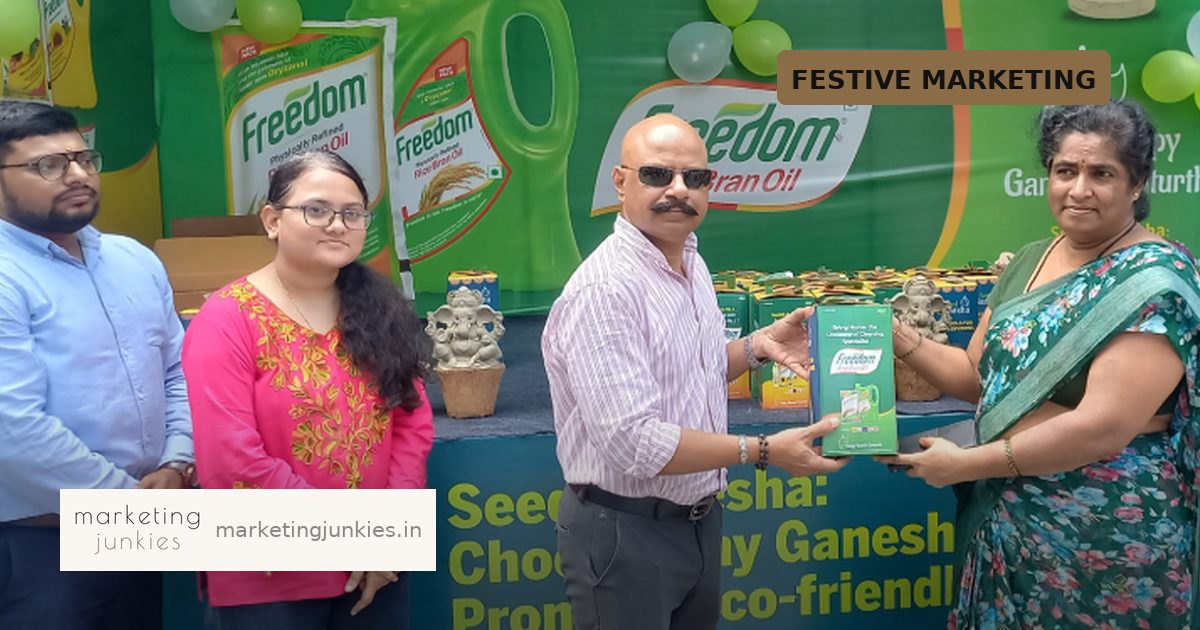
Gemini Edibles and Fats India Ltd (GEF India), the company behind Freedom Healthy Cooking Oils, is back with its Green Ganesha initiative this Ganesh Chaturthi, distributing 10,000 eco-friendly Seed Ganesha Murtis across Hyderabad and Bengaluru.
The split is even: 5,000 Seed Ganesha Prosperity Boxes in Hyderabad and 5,000 in Bengaluru. The idea is simple and tactile. Instead of a plaster-of-Paris idol that lingers in a lake long after visarjan, families get a murti embedded with plantable seeds. Immerse it in a pot of water at home, and it eventually gives rise to a plant.
How the activation is being run
Chetan Pimpalkhute, Marketing Head, Freedom Healthy Cooking Oils, flagged off the distribution vehicles in Hyderabad along with the company team. Rather than a retail-led giveaway, the brand is going door-to-door into gated residential communities.
Among the societies on the route: Ridge Towers, My Home Jewel, One City, Sai Mithra Towers, Krishnakunz Gardiniya, Malaysian Townships Rain Tree Park, Swanlake Apartment, Rainbow Vista, Janapriya Metropolis Apartments, Satellite Apartment, Vertex Prime and Rainbow Vistas Rock Garden-1&2.
That community-first routing matters. Apartment complexes in Hyderabad and Bengaluru are where festival pandals, WhatsApp groups and family decision-making all converge, which makes them a high-density, low-waste distribution channel for a physical sampling exercise.
Seven years, not seven days
The most instructive detail for marketers is longevity. P Chandra Shekhara Reddy, Senior Vice President, Sales & Marketing, Freedom Healthy Cooking Oils, said the company has been distributing eco-friendly seed Ganesha murtis for seven years, and framed the effort as giving people “freedom to celebrate the festival with traditional fervour” in a sustainable way.
Pimpalkhute positioned the murti as an effort to bring faith, tradition and sustainability together, noting that instead of ending with immersion, it can grow into a new plant symbolising growth and renewal. He also flagged children as a key audience the brand hopes to reach.
Seven consecutive years turns a seasonal stunt into an owned property. That is the difference between a campaign consumers scroll past and one a housing society starts expecting each year.
Why this matters for brand teams
Festive marketing in India is crowded, expensive and largely undifferentiated. Every category floods the same weeks with the same emotional beats. A physical, useful, low-cost object cuts through in a way another 30-second film usually cannot.
The environmental angle also has real grounding. Traditional idols made from plaster of Paris and finished with commercial paints take far longer to dissolve, which has pushed consumers toward clay and water-soluble alternatives. A seed idol simply extends that shift one step further.
Four things to borrow from this playbook
- Solve a friction, not a fantasy. Many families already want a greener visarjan but do not know where to source an idol. The brand removed that step.
- Pick a distribution channel that mirrors the ritual. Homes and housing societies, not modern trade shelves, are where the product gets used.
- Commit to repetition. Year seven is when an initiative becomes a brand asset. Most CSR-adjacent activations are abandoned by year two.
- Build in an afterlife. The murti keeps working post-festival as a growing plant, which extends recall well beyond the ten-day window.
The category fit
For a cooking oil brand built on a “healthy” proposition, a health-of-the-environment story is a reasonable adjacency. It links kitchen and household, which is exactly where the purchase decision sits. The activation also gives regional sales teams a reason to be physically present in Hyderabad and Bengaluru communities during peak festive spend.
The takeaway for marketing teams planning next year’s festive calendar: a sustainability message lands hardest when it is embedded in an object people already plan to buy, rather than bolted on as a hashtag.
Source: MediaNews4U