
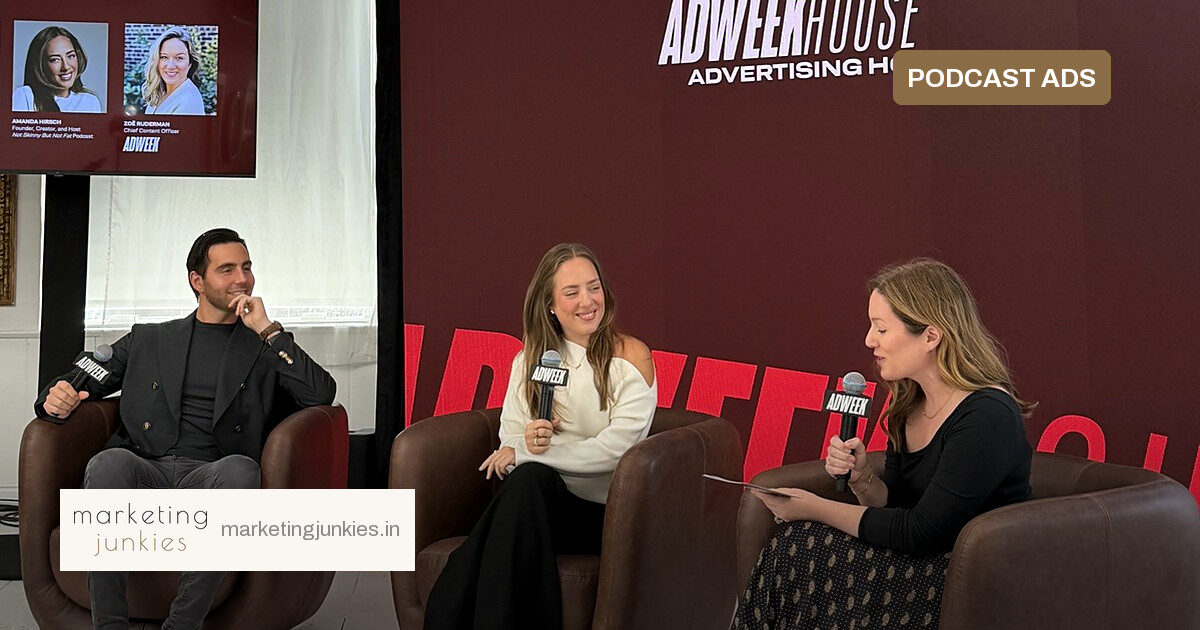
At Advertising Week, podcast host Amanda Hirsch and Dear Media’s Mark Mullett made a simple case for podcast ads: the most effective brand integrations rarely begin with a script.
Hirsch, host of Not Skinny But Not Fat, told ADWEEK’s Zoe Ruderman that she filters every prospective sponsor through three questions: Is it a brand she already uses? Has she actually tried the product? Would her audience genuinely find it useful?
If the answer is no, she turns the deal down—even when the money is attractive. She has also accepted lower fees from brands she already loves, because the recommendation feels natural to her listeners.
Why host-read beats programmatic
Dear Media operates around 100 shows with a sales team of roughly 40 people. It rarely runs programmatic advertising. Instead, the network leans on host-read placements that talent can shape directly with the brand, according to Mullett, Dear Media’s president of global entertainment.
That model is not just a preference; it has become the business. Last year, Dear Media was on track to generate between $50 million and $100 million in revenue, after having raised around $12 million, per The New York Times.
Mullett said the most common brand mistake is handing a creator a script and expecting it to be read word for word. Another misconception is that creators will take any offer for the money.
Let creators create. If they said yes to working with a brand, let them cook, let them do their thing. It’s going to be better for you.
What a good partnership looks like
Video has expanded the format beyond a mid-roll mention. Dear Media has moved into product placement on set, IRL events and raw footage spliced into episodes.
One recent example was Weight Watchers, where the partnership included a show hosted by a company employee about her own GLP-1 journey. The focus was not the science, but the psychological and personal side of the experience—what Mullett called great entertainment brought to you by Weight Watchers.
For Hirsch, success is not about dashboards either. She mostly ignores the numbers until quarterly reports arrive. An episode works when listeners fall for a guest they had never heard of before.
Her dream partner, after years of organically talking about the brand, is Ugg.
What marketers should do
- Audit the creator’s actual product use before signing a deal.
- Replace full scripts with talking points and brand guardrails.
- Judge host-read campaigns on listener response, not just immediate conversion.
The difference often comes down to whether the host can talk about the product in the same tone they use with a friend. That only happens when the creator has real experience with it.
For brands, the lesson is clear: give creators room to talk the way their audience expects, and the ad stops sounding like an ad.
Source: Adweek