
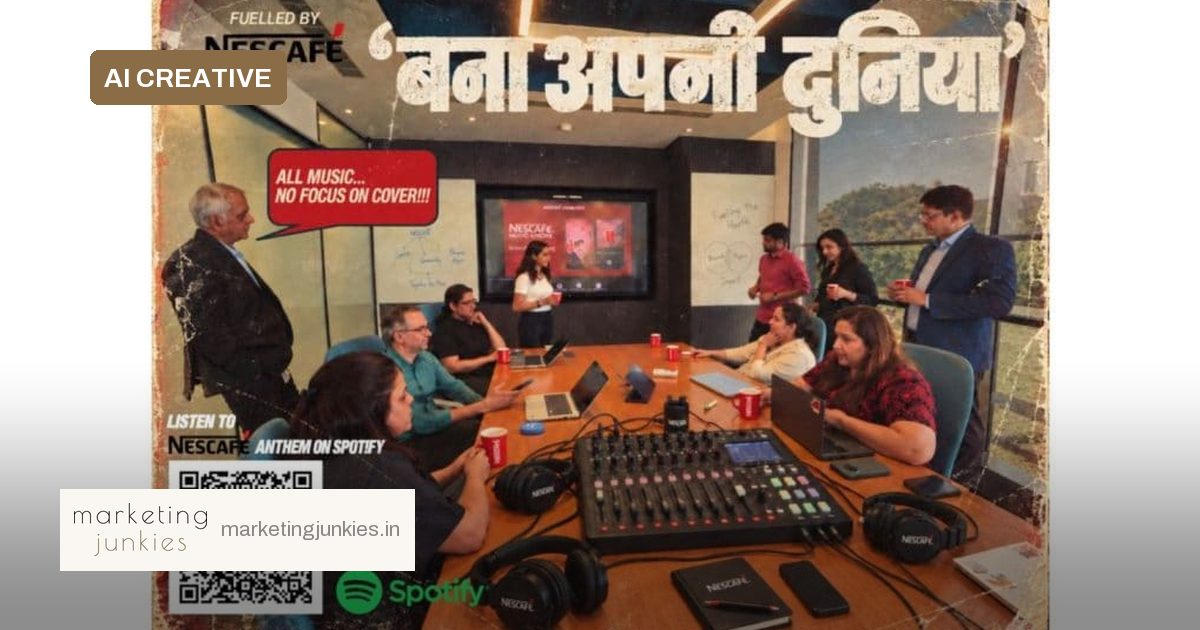
Nestlé India chairman and managing director Manish Tiwary recently gave marketers a small but instructive look at how generative AI is entering the creative workflow. A Nescafé rap was already live on Spotify, but it had no album cover. Tiwary created one himself using AI, posted the visual on LinkedIn, and added a QR code that led straight to the track.
He described the move with self-deprecating humour as the work of a “completely unqualified creative director,” while also acknowledging the brand and design teams. The post may have been casual, but it surfaced a bigger shift: the traditional route from brief to agency to creative development to design is no longer the only path.
Idea-to-execution is getting shorter
For a marketer with an idea, a visual route can now be generated in minutes. What once required a formal brief, an agency response, creative routes, feedback loops and design refinements can begin with an AI-assisted first draft. That does not mean production discipline disappears. It means the first visualisation can sit much closer to the person who spotted the opportunity.
For agencies and creative teams, this creates a different role. Instead of only producing initial concepts, they can focus more on refining, shaping and translating those early AI-generated directions into broader brand systems and campaigns. Senior marketers, in turn, become more direct participants in creative development—blurring the old line between commissioning work and making it.
Why this matters for brand teams
Nescafé is a fitting brand for this experiment because its communication has often been built around culture, conversation, youth and everyday moments. Taking the brand into a music format on Spotify extends that territory beyond conventional advertising. But the takeaway is not that every marketer should become a designer. The task is to use AI where it speeds up a real need—like a missing album cover—without loosening brand control.
AI can change production speed, but it does not change the fundamental requirement that the output stays recognisable, relevant and consistent with the brand’s storytelling codes. A generated image is only useful if it fits the brand world it is meant to support.
What teams can do next
For marketing teams evaluating generative AI in their workflow, a practical starting point is to treat AI assets as early creative capital, not finished campaign systems:
- Use AI to create quick visual routes, comps or first drafts before committing to a full production cycle.
- Run every AI-generated asset through brand and design teams for relevance, consistency and tone.
- Keep the brand’s existing codes as the filter—AI should accelerate execution, not replace judgement.
- Allow agencies to focus on scaling, refining and systemising the strongest directions.
The broader lesson from Tiwary’s post is not that AI can simply make an image. It is that the person who identifies a creative opportunity can now participate more directly in turning that opportunity into an asset. For brands, the advantage will come from using that speed while preserving the craft and consistency that made the brand recognisable in the first place.
Source: Storyboard18