
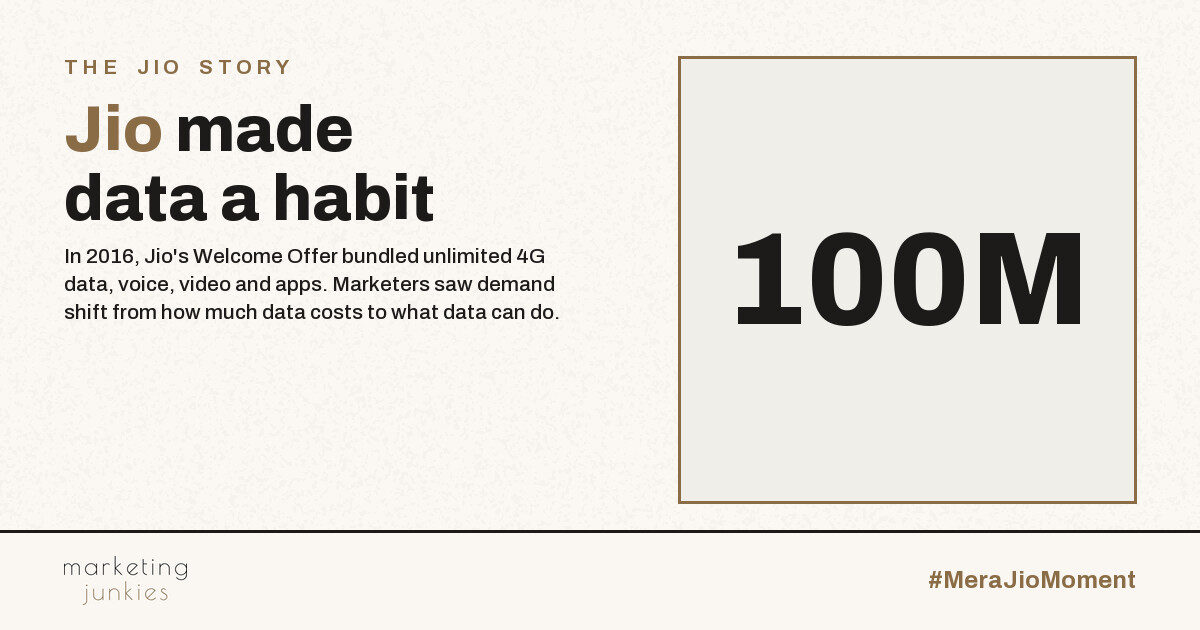
In 2016, Indian marketing still planned around data as a monthly ration. For many consumers, a video call or a long stream was a decision, not a reflex. Then Jio’s Welcome Offer bundled unlimited 4G data, voice, video and apps, as Reliance Industries describes it. The change was not just a network launch; it was a reset of consumer expectations.
What the offer changed
Consumers had learned to check a meter before streaming a video, making a video call or downloading an app. The Welcome Offer removed that pause for a large base of users. The company reported 100 million subscribers within 170 days of launch.
Almost overnight, behaviour that had been rationed became ordinary. Long-form video, live updates, app downloads and video calls moved from occasional experiments to daily habits. Marketers noticed because the audience was no longer pre-filtering itself by data anxiety.
The demand shift marketers could work with
The question India asked moved from ‘How much does data cost?’ to ‘What can we do with data?’. That reframing changed campaign planning.
- Video became a default format, not a premium add-on.
- App-first journeys and always-on messaging became realistic at scale.
- Regional and user-generated content found a broader, more active audience.
- Measurement began to follow behaviour across sessions, not just reach in one slot.
The shift was also about trust. When data was scarce, every ad had to earn its megabytes. Once data felt unlimited, consumers tolerated longer formats, frequent updates and interactive experiences. That tolerance changed what a good campaign could look like.
From one offer to an infrastructure lesson
Jio’s ecosystem today spans connectivity, entertainment, commerce, payments, devices, cloud and AI, Reliance Industries stated at its 48th AGM in August 2025. Its stated priorities are to connect every Indian, bring digital services home, digitise businesses, and work towards AI Everywhere for Everyone. The Welcome Offer was an early signal that when a constraint disappears, habits and expectations move quickly.
The original Welcome Offer looks less like a tariff event and more like an audience behaviour shift. Marketers who were in the market then remember the switch in client conversations: from data budgets to content plans, from short slots to session-based journeys.
Today, Jio serves 524 million plus customers, a company-reported figure from Reliance Jio Infocomm in March 2026. That scale makes the 2016 lesson easier to see: infrastructure builds the stage, but consumer behaviour writes the script.
What marketers can carry forward
The marketing lesson from 2016 is not about copying a single plan. It is about recognising that scarcity shapes behaviour and abundance reshapes it. Jio did not simply make connectivity abundant; it made a bundle of capabilities the starting point. Brands that plan for continuous attention, app-led journeys and regional creative are building for the behaviour that the Welcome Offer made normal.
For many younger consumers, the idea of waiting for data to load is already distant. The marketer’s job is to act on that expectation, not to wait for it to be proven again.