
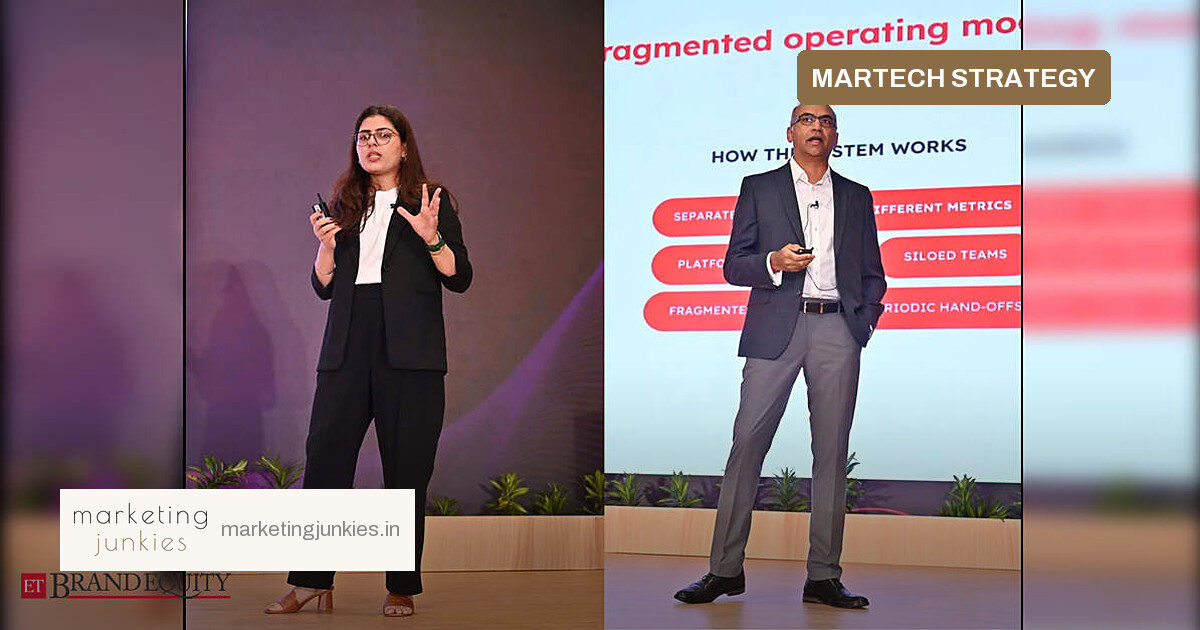
Marketing leaders have spent years adding tools, dashboards and AI pilots. But at MarTech+ Summit 2026, Publicis Sapient’s Harshita Arora and Ajey Kumar argued that the next unlock is not another technology deployment—it is connectedness across the enterprise.
Arora, country marketing lead at Publicis Sapient, opened with the new growth mandate. In a session titled ‘From Missing in Action to Marketing in Action: Connecting the Enterprise for Growth,’ she cited a stark figure: 78% of CEOs look to marketing to help drive growth.
A wide gap between mandate and readiness
The problem, Arora said, is that most marketing organisations are not built for the expanded scope. Only 27% of CMOs in a global survey said they have the operating model needed to deliver on these new expectations. That leaves 73% without the architecture to turn the mandate into measurable business outcomes.
“78% of CEOs look at marketing to help drive growth. That’s a very big number. The mandate has changed. The scope has expanded.”
The disconnect is not about effort. Teams are busy, Arora noted, but AI has multiplied workflows, pilots and dashboards—many delivering in silos. Signals stay disconnected and data remains unstructured, making it harder to read customers or coordinate action across functions.
Why more tools can deepen the problem
Ajey Kumar, executive client partner at Publicis Sapient, described a familiar breakage: divisions often work well internally, but context fails to flow from one team to another. That handoff tax keeps organisations stuck in Horizon 2—unable to move to Horizon 3 because they cannot connect the five pillars that would unlock the next stage.
Kumar’s proposed fix is what he called a nerve centre: a central mechanism that cuts across silos, makes sense of signals and minimises the cost of every handoff.
He was clear that this does not require ripping out existing martech. Organisations do not need to replace their current CRM systems or their agencies, he said. What they need is something that brings those investments together.
What Publicis Sapient is pitching
Kumar positioned Sapient Bodhi, Publicis Sapient’s core engine, as that integration layer. It is designed to build an Enterprise Context Graph across structured and unstructured data, so context can move across systems, teams and people.
Governance was part of the argument too. No single team owns responsible AI, Kumar said, but everyone is accountable for it. That demands enterprise-level guardrails rather than team-level ones.
Where marketers can start
Kumar’s closing advice was deliberately incremental:
- Map the organisation and find where context breaks between functions.
- Connect one loop end-to-end before scaling further.
- Focus on eliminating handoffs and reducing the handoff tax as the measure of success.
For Indian and global marketing leaders, the summit’s message is a useful pressure test. Before buying another platform or launching another pilot, ask whether existing tools, data and teams can actually talk to each other around a shared business outcome.
Source: ETBrandEquity.com