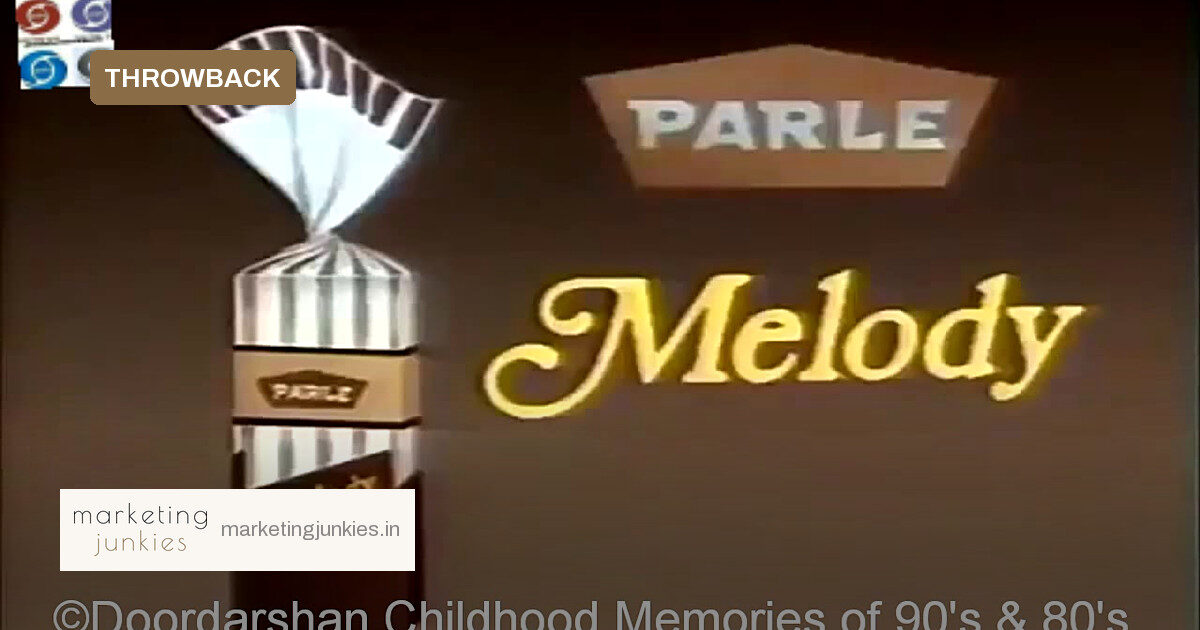
The campaign
Parle Melody was already a familiar impulse buy when the brand put a simple dare at the centre of its advertising: Melody Khao Khud Jaan Jao—eat a Melody, and find out for yourself.
Before the dare became the campaign, Indian confectionery advertising often leaned on cuteness, family moments or straightforward product claims. Parle Melody went a different way: it made the tagline a call to action rather than a description.
The film belongs to Doordarshan’s era of high-recall television advertising, when a jingle could enter household speech. The agency behind the work is not widely documented today, but the line and the tune became inseparable from the product.
What the film said and how
The ad never tried to explain the toffee’s flavour or layers. It made a promise by refusing to make one: the only way to know what Melody tasted like was to eat one.
That refusal was the creative device. The jingle repeated the line enough to make it a chant, and the film kept returning to the moment of the first bite, leaving the taste to the viewer’s imagination. A bright, singable tune did the heavy lifting; no voiceover had to argue that Melody was smooth, sweet or different. The tagline was the product demo.
The structure left no room for comparison or a hard sell. It was built for earworm recall, which suited the Doordarshan schedule where reach was broad but attention was incidental.
By turning a low-involvement purchase into a tiny suspense, the ad gave children a reason to ask for it and adults a reason to remember it.
The response it got
The campaign became one of Indian confectionery’s most durable jingles. It did not need a continuing media push to stay alive; the line stayed in playgrounds, in throwback lists and, later, in social media nostalgia.
It is remembered less as a sales pitch and more as shared cultural shorthand. People who grew up with Doordarshan can often finish the line before the brand does. That level of recall is rare for a product as small as a toffee.
The line crossed into everyday banter, which is an unusual outcome for an impulse toffee. That cultural stickiness became the brand’s main asset.
Sales figures from that period are not reliably available, but the campaign is credited with giving Melody a long tail that outlived many louder competitors.
What it changed in the category
Melody’s dare shifted confectionery advertising from describing the sweet to inviting consumers to judge it. It showed that a well-built jingle can do the work of a product benefit.
- The product was the hero, not an animated ingredient claim.
- The consumer became the tester; the ad only asked for a trial.
- A repeatable earworm gave the brand a place in daily speech.
The campaign showed that a challenge tagline works best when the product experience can close the loop. A consumer who tries the toffee and likes it completes the story the ad starts.
After this, many Indian impulse brands chased the same structure: a simple line, a catchy tune, and a challenge that made the consumer the final proof.
Where the brand and the idea are now
Parle Melody is still on shelves, and the tagline still appears in the brand’s packaging and nostalgic social content. The line now works as a throwback that older consumers pass on, while the product continues to sell to new impulse buyers.
The brand’s current marketing often plays back the old line as a memory trigger, which makes the campaign a living asset rather than a closed chapter.
The idea has not needed a reboot. The brand occasionally refreshes the pitch, but the original dare remains the reference point. It is proof that a jingle can become a brand’s entire memory structure when it invites the consumer into the payoff.
Watch the original: Parle Melody on YouTube