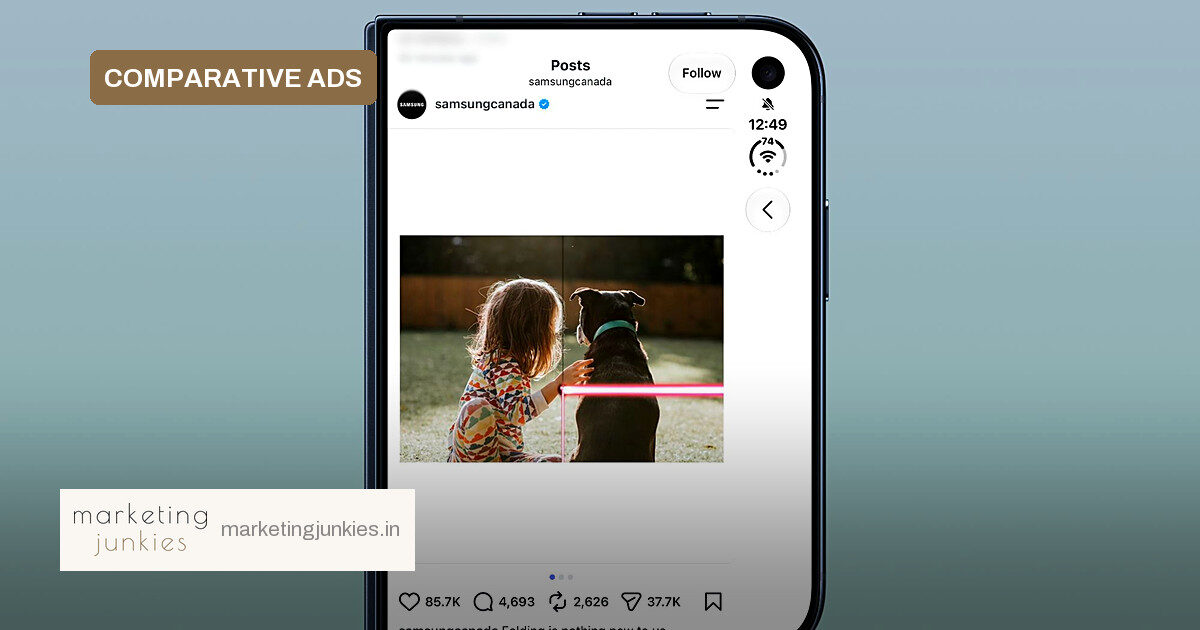
Samsung is turning a rival’s hardware headache into marketing ammunition. This week, the company’s Canadian Instagram account launched a three-image campaign that puts the iPhone Duo’s inner-display cracks front and centre.
The visuals draw a bright line through the fold area—the same spot where some iPhone Duo owners have reported cracks and a glowing OLED line—then deliver a simple brand contrast. The copy is short and pointed:
- “Folding is nothing new to us.”
- “Folding. We know a thing or eight.”
- “Switch to Galaxy Z Fold8.”
A Samsung spokesperson described the work as a “playful new campaign” that leans into the “growing rivalry in foldables and how experience plays in the category.”
Why the jab works
The campaign is not just a punchline. Shortly after the iPhone Duo went on sale, some users reported hinge problems that caused cracking in the inner display, often in the same location. Apple has acknowledged the issue, says only a small number of units are affected, and directs customers to AppleCare for a replacement.
Samsung’s strongest move is framing the moment as an experience gap. It notes that its first foldable launched in September 2019 and that the Galaxy Z Fold8 debuted three months before the iPhone Duo. That turns a product-quality story into a category-credibility story—an important distinction for buyers comparing first-generation Apple hardware with an eighth-generation Samsung line.
Experience meets availability and price
The timing also gives Samsung running room on the commercial side. The iPhone Duo is backordered until January for online orders, though Apple has had sporadic in-store availability. Samsung says many Galaxy Z Fold8 colors and capacities are delivering on November 3, with no apparent supply constraints.
Price sharpens the contrast: Apple’s iPhone Duo starts at $1,999 for 256GB, while Samsung charges $1,899 for the same storage. That’s a $100 difference for buyers already nervous about durability.
What marketers can take from it
This is comparative advertising with a clear structure: anchor on a specific rival flaw, respond with your own track record, and make the alternative concrete with price and delivery dates. The creative works because the flaw is visible and the brand has a relevant proof point, not just a taunt.
The risk is that comparative campaigns invite more scrutiny of your own product and can read as opportunistic if the claim feels exaggerated. Samsung keeps the tone light, uses the phrase “playful,” and stops short of making broad quality claims about Apple’s entire lineup.
For foldable-curious shoppers, the choice now includes more than specs—it includes evidence of experience, supply certainty, and a lower entry price.
Source: MacRumors