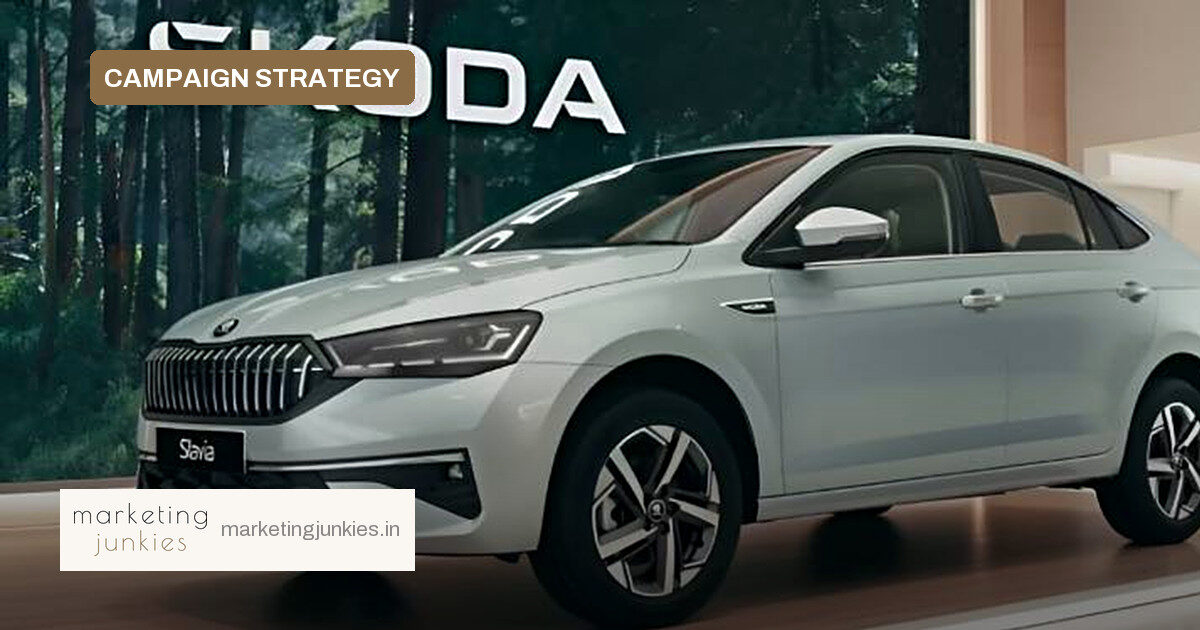
Most car launches talk about horsepower, boot space and connectivity. The new Škoda Slavia is taking a different route. Škoda Auto India and BBH India have rolled out “Says It All.”, an integrated campaign across film, print and OOH that avoids the usual spec sheet and lets the car’s character do the talking.
The campaign, from odd films to a donated billboard
At the centre are two short films built on conversations that have little to do with cars. One explores the curious fact that a cow can walk up a flight of stairs but cannot walk back down. The other starts with the equally unexpected subject of a drunk ant. Both meandering chats eventually find their way back to the new Slavia, without ever switching into a conventional features pitch.
The idea then moves into print, where a series of redacted ads deliberately conceal key details of the car. The absence of information becomes the message: the Slavia is familiar enough that readers can fill in the blanks.
The boldest expression sits in OOH. Škoda is giving away one of its outdoor sites to Indian homegrown businesses and brands, offering them a platform to tell their own stories. Instead of using that space to advertise the new Slavia, the brand steps aside. It’s a demonstration of the campaign promise: when your product truly speaks for itself, you can afford to let others do the talking.
- Two films use unrelated facts—a cow on the stairs and a drunk ant—to build intrigue before the car appears.
- Print ads redact Slavia details, making absence the creative device.
- One OOH site is handed to other Indian brands rather than used for Slavia advertising.
Why brand confidence can be a media strategy
Ashish Gupta, Brand Director at Škoda Auto India, says the campaign is meant to reflect the Slavia’s sedan legacy and connect with a new generation of customers who appreciate design, performance and European engineering. Parikshit Bhattacharya, Chief Creative Officer at BBH India and Propagate India, adds that the car already enjoys a strong fan base, and fans already know the product. That gave the team freedom to move beyond a traditional car campaign.
This is a useful example of brand-led attention. Instead of spending the OOH moment on another product visual, Škoda turns the media placement itself into news. The giveaway likely generates more earned conversation for the launch than a standard billboard would, precisely because it surprises people. In crowded categories, that kind of media gesture can cut through when product claims blur together.
Of course, restraint works best when brand equity already exists. A challenger with no awareness still has to explain what it sells. The Slavia can afford to underplay; not every product can.
What marketers can test
The takeaway isn’t to copy the cow-and-ant script or hand over your media budget blindly. It’s to align creative restraint with existing brand strength. If customers already champion the product, an odd idea or an unexpected media move can be more persuasive than another list of features. If they don’t, clarity should come first.
The campaign is live across digital, print and OOH, and it will be worth watching whether the donated billboard creates the kind of talkability the launch is designed to earn.
Source: MediaNews4U