
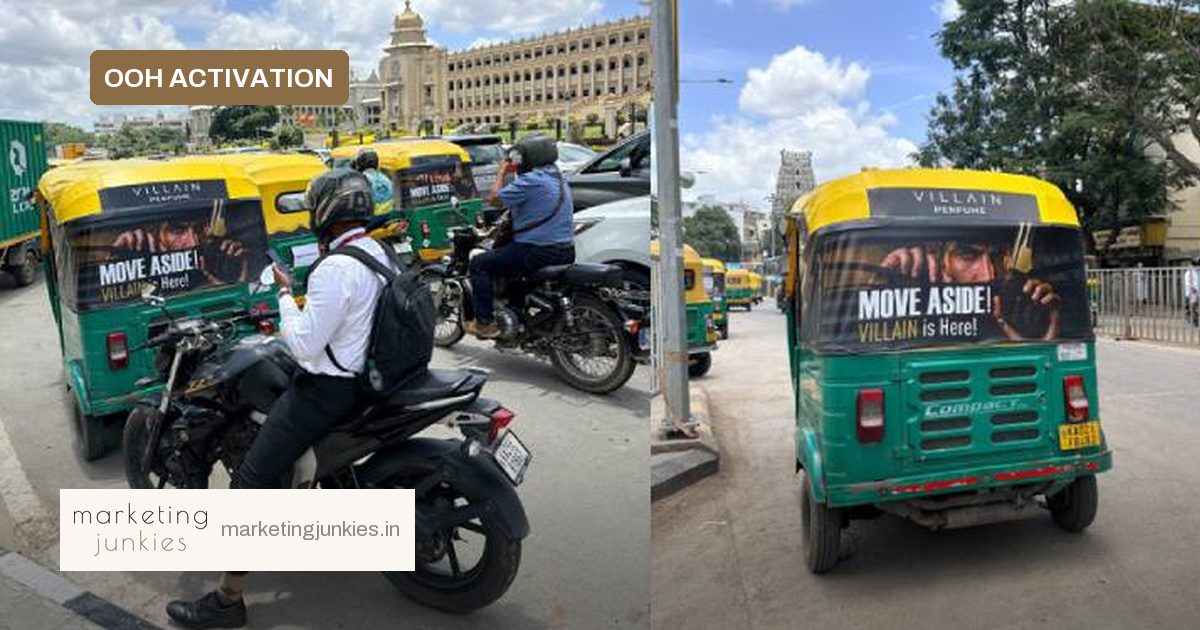
Villain, the men’s grooming and fragrance label owned by BRND.ME, has taken its Gold Revolver Eau de Parfum onto Bengaluru’s streets in its first out-of-home and experiential campaign. For two days, auto rickshaws wrapped with the brand’s revolver-shaped perfume bottle moved through key hubs such as Russell Market in Shivajinagar, Vidhana Soudha and Koramangala.
The activation treats the city’s famous traffic not as an obstacle but as a media opportunity: a slow-moving auto stuck in congestion becomes a repeated visual touchpoint for commuters.
A street-level canvas
Villain positioned the Gold Revolver as India’s only revolver-shaped perfume and made it the visual centrepiece. The campaign uses a bilingual line — “Move Aside! Villain is Here!” in English and “Leyy! Villain Bartha Idey!” in Kannada — to connect with both local and cosmopolitan audiences.
Instead of buying conventional billboards, the brand converted everyday auto hoods into moving brand canvases, putting the product identity into Bengaluru’s daily commute.
From performance to presence
The move is significant because Villain’s marketing until now has been mostly performance-led: D2C funnels, marketplaces, quick commerce and influencer awareness. Its first OOH experiment signals a shift toward brand-building beyond screens, executed fully in-house.
A BRND.ME spokesperson said the brand wanted to take Gold Revolver “beyond the screen and onto the streets,” and that Bengaluru’s traffic was made part of the campaign rather than worked around.
- OOH can work for digital-first D2C brands when the creative fits the vehicle.
- Local-language messaging helps a brand feel native to a city.
- Congestion and transit routes can be repurposed as low-cost, high-frequency reach.
What marketers can borrow
The core tactic is simple: identify an unavoidable part of city life — traffic, queues, station platforms — and turn it into a branded moment. For D2C brands that have saturated digital performance, street-level visibility can support recall and local relevance without a traditional billboard budget.
Villain plans to explore similar on-ground formats across other Indian cities as it expands beyond performance channels, making this activation a test case for scalable transit-based branding.
Source: MediaNews4U