
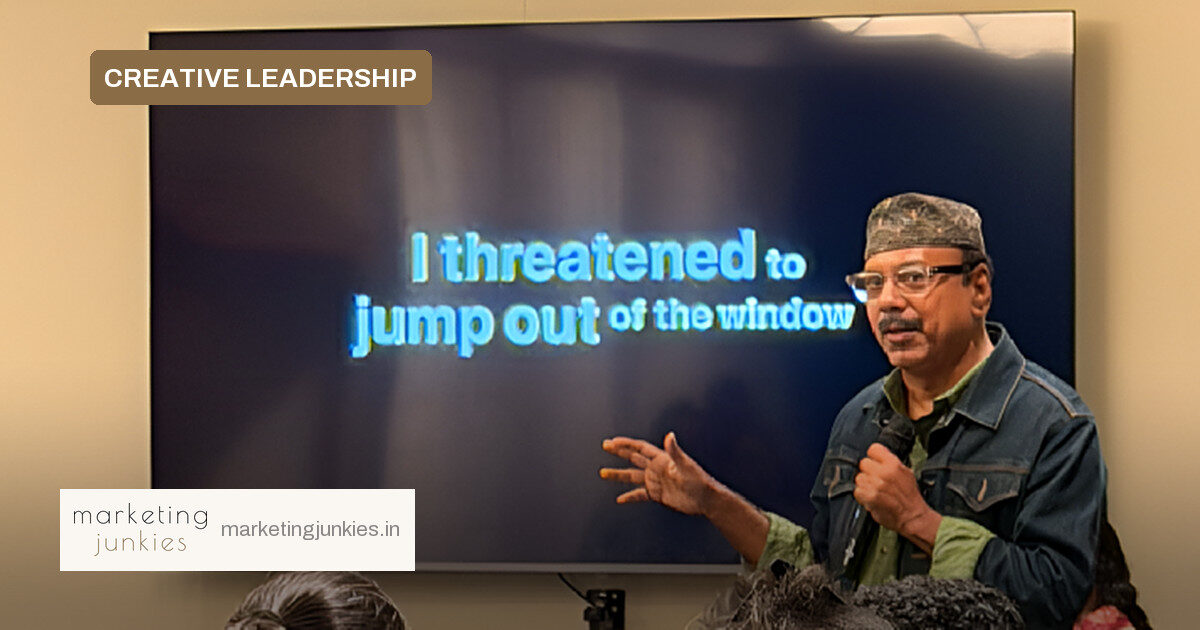
Josy Paul has spent more than three decades in advertising, but he argues the craft cannot be mastered once and then repeated. Speaking at AdTalks by Advertising Club Madras, the Chairman and Chief Creative Officer of BBDO India described creativity as a live tension between instinct, discipline, vulnerability and cultural action. His message for marketing professionals and students was deliberately simple: protect your curiosity more than your expertise.
Stay a lover, not an expert
Paul’s central thought was that an expert defends accumulated knowledge, while a lover remains open.
“The expert is trying to protect his or her turf. But the lover is always in love.”
That distinction, he explained, is why creative people need to stay restless. Expertise can become a comfort zone; love keeps you changing as media moves from print to television to internet and to culture-driven participation.
From front-page disruption to creative acts
Paul’s career examples doubled as proof. He recalled an early Nike print ad that opened his eyes to advertising as a way to address social exclusion, an India.com campaign that placed advertising on the front page of The Times of India, co-founding David, walking away after a merger, and building BBDO India from 2008 around the phrase “creative acts, not ads.”
The goal, he said, is to move brands from sending messages to making commitments audiences can join. That shift showed up in two well-known BBDO India campaigns:
- Whisper’s Touch the Pickle confronted a menstruation taboo instead of leading with product features.
- Ariel’s Share the Load started with “anyone can remove a stain in one wash” and grew into a long-running exploration of household inequality, women’s health, relationships and mental load.
Emotional data and individual truths
Paul was careful not to dismiss data. His argument is that conventional data reveals patterns, while emotional data reveals why those patterns matter. He described an eBay exercise in which the team did not start with research decks. They asked people a plain question: “Why do we buy things?” The conversation turned personal, and the creative platform emerged from individual truths rather than demographic segments.
“It’s not an insight. It’s an individual truth, which everybody connects with.”
“People are looking for meaning, not brands,” Paul said. For agencies, that means creatives need to be listeners and interpreters, not people walking into a room with a ready answer.
The freedom to fail
Paul credited leaders including Suresh Panicker and Alec Padamsee for shaping his journey. Padamsee promoted him to Creative Director early but could not match the pay of more experienced leaders. In return, he offered something Paul called more valuable: the freedom to fail.
“Failure, embarrassment and rejection are your best friends,” Paul said. “Success won’t shift. It keeps you in the same place.”
He also tied discipline to surrender. A physics graduate, he said creativity needs fundamentals and craft, but also space to let go.
“Think like the Navy, but be like the pirates.”
Hiring for the future
Paul applies the same lens to team-building. He said he is less interested in what a candidate has already done than in where they might take the agency. “The work is the past. I want to know what this person will take us into the future.” He recalled hiring people from unconventional backgrounds, including a baker whose openness convinced him she could contribute something new.
For marketers, the practical summary is straightforward: seek the individual truth under the data, keep a cultural idea alive by digging into another layer each year, and build teams for potential rather than past work.
Source: MediaNews4U