
Marketing’s biggest untapped upside may not be in the categories that already worship it. It may be sitting in the ones that have long treated it as a support desk — law, accounting, insurance, manufacturing.
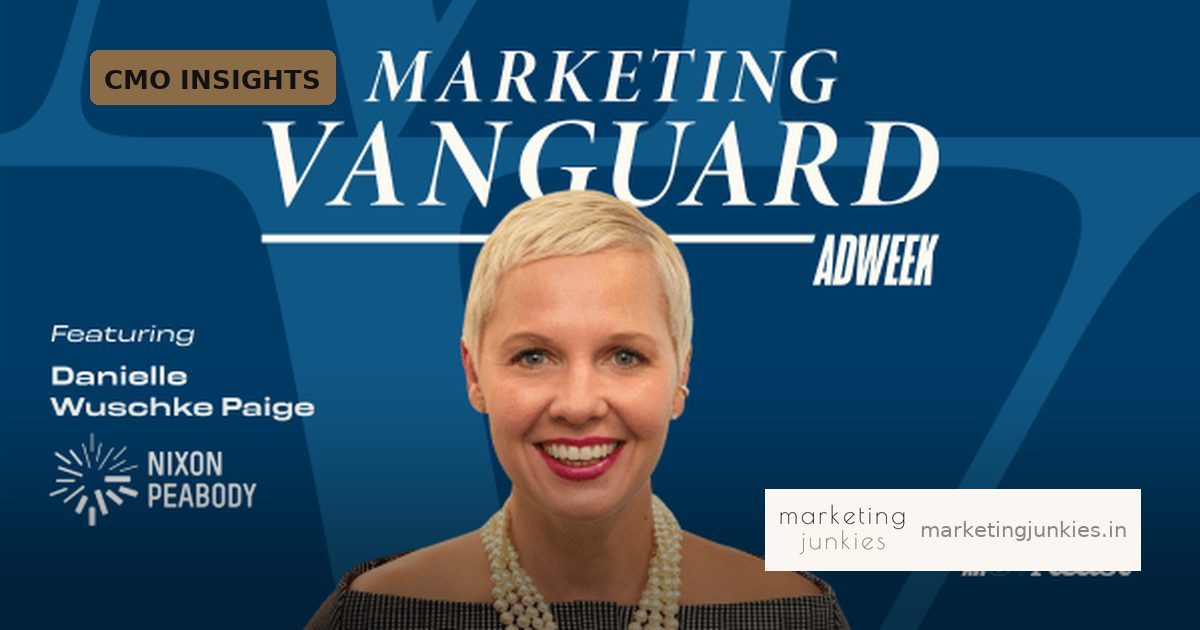
That is the argument Danielle Wuschke Paige, chief marketing and growth officer at Am Law 100 firm Nixon Peabody, makes on Adweek’s Marketing Vanguard podcast with host Jenny Rooney. Her beat is legal marketing, an industry built on relationships, referrals and reputation — and one where, by her account, marketing teams have historically been kept busy with execution rather than strategy.
From agency floors to a law firm
Wuschke Paige’s route is instructive for anyone eyeing a category switch. She started in technology sales, moved into strategic marketing, and then spent more than 15 years in agencies, including leadership roles at FleishmanHillard and MSL. Her point: strong B2B fundamentals travel. You can learn an unfamiliar category; you cannot fake the discipline of positioning, audience insight and channel strategy.
At Nixon Peabody, she leads brand strategy, communications, client engagement, strategic pursuits, digital, design, industry marketing and practice growth. The modernisation brief, she says, was never a logo refresh. It was reconnecting marketing activity to firm-wide growth, practice priorities and individual attorney development — and then getting lawyers to see why that mattered commercially.
The trust gap is a content gap
The most quotable data point in the episode is a client one. Nixon Peabody’s 2024 client engagement survey found that clients wanted to hear from the firm roughly three times more often than they actually did — specifically through timely, useful content that helped them make sense of fast-moving legal and business issues.
That is a rare thing in modern marketing: an audience explicitly asking for more. It reframes legal marketing as content-first, where relevance and credibility outrank volume and polish. For Indian marketers in professional services, consulting, BFSI or B2B SaaS, the read-across is direct: your clients are probably under-served on interpretation, not over-served on advertising.
The partner is the brand
Wuschke Paige also makes a point that sits awkwardly with traditional brand governance. The firm brand carries equity, but the personal reputation of an individual attorney can be the stronger driver of business. Well-known partners bring credibility into specific industries, and that halo lifts their wider teams.
So a large part of the job becomes partner-first reputation building — helping experts become visible ones. Practically, that means:
- Identifying the handful of experts whose credibility actually converts, not everyone with a title
- Building repeatable thought leadership formats around their view, not generic firm content
- Coaching for visibility — commentary, panels, LinkedIn, bylines — with editorial support behind it
- Keeping one consistent firm voice while allowing individual expression
- Measuring reputation outcomes against practice growth, not impressions alone
AI as an amplifier, not a shortcut
Nixon Peabody is already using AI internally for workflow, analysis, firm data and marketing experimentation. But Wuschke Paige is careful about where the line sits. AI can help teams move faster and think more broadly; it should not hollow out the foundational skills junior marketers need — writing, communication and creative judgment.
She extends the same logic to legal services: AI may reshape delivery, but clients still pay for experienced human judgment. It is a useful frame for any marketing leader building an AI policy this year — automate the process, protect the craft.
Why it matters
Legacy industries are where marketing leverage is highest precisely because expectations are lowest. The playbook here — prove commercial impact, publish faster than competitors, build people-brands, adopt AI without deskilling the bench — transfers well beyond law.
Source: Adweek