
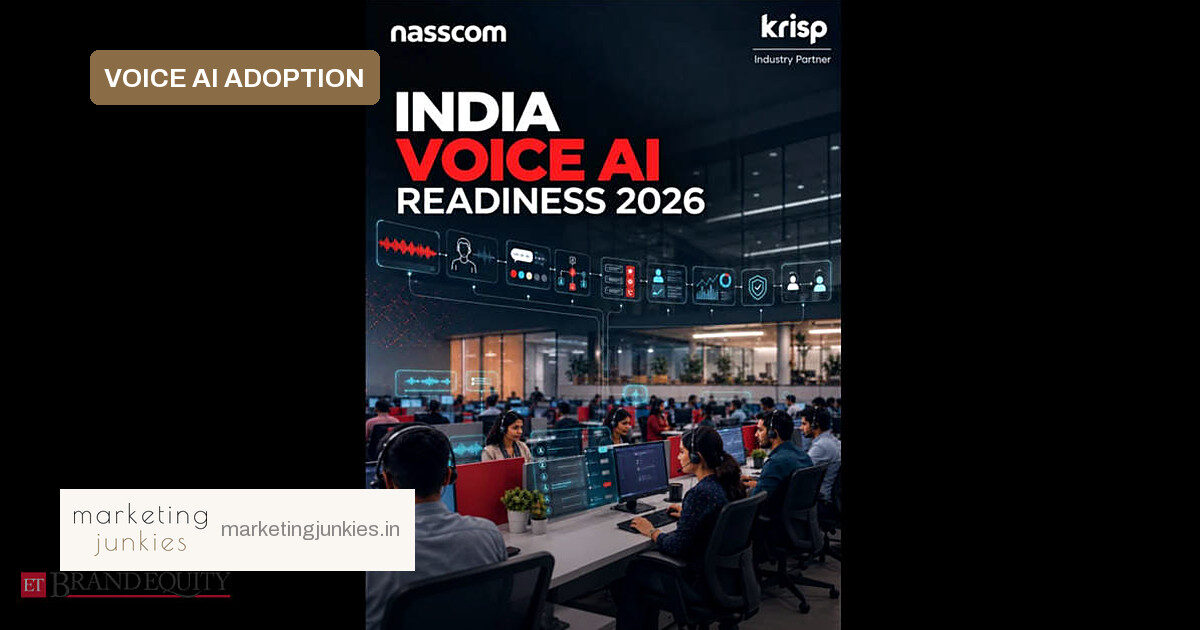
India’s Voice AI moment is still more pilot than production. A new Nasscom report, developed with Krisp, finds only 13% of organisations have scaled Voice AI across multiple customer journeys, even as most enterprises report early efficiency gains.
The adoption split
The India Voice AI Readiness 2026 report, based on 140 organisations including BPM providers and global capability centres, maps a typical maturity curve. About 23% are still exploring, 32% are running proofs of concept and 31% have reached limited production. Only 9% say Voice AI handles more than half of their eligible customer interactions.
- 23% still exploring Voice AI
- 32% running proofs of concept
- 31% in limited production
- 13% scaled across multiple customer journeys
Efficiency is real, business impact is patchy
Cost and speed are the strongest part of the case. The report says 61% of respondents cut cost per eligible interaction by more than 20%, and nearly two-thirds saw a 10–30% reduction in average handling time. But measurement is still narrow: only 14% track business impact comprehensively, while 45% measure only selected deployments.
That matters because mature deployments tell a different story. Around 30% of organisations with scaled Voice AI report a positive revenue impact, compared with 13% in limited-production environments. On returns, 68% say they realised ROI within six to 24 months, while 18% are yet to see returns.
Multilingual accuracy, not language count
India’s linguistic diversity is both the opportunity and the friction. More than a third of organisations already support three or more Indian languages, but over 30% report inconsistencies in how AI handles regional accents. In live conditions, background noise is the top performance challenge at 32%, followed by switching between languages at 24% and accent or speech variation at 18%.
“India’s multilingual, multi-accent and often noisy contact center environment makes it one of the most demanding markets for Voice AI,” said Davit Baghdasaryan, co-founder and CEO, Krisp.
Nasscom sees a competitive opening. Among organisations supporting three to five languages, 29% identified opportunities in North and Latin America and 27% saw opportunities in Europe and the UK.
Where spending goes next
Investment plans are rising. The survey found 35% of respondents expect Voice AI budgets to grow by more than 25%, and another 45% expect increases of up to 25%. Multilingual accuracy leads the priority list, ahead of real-time agent assistance, quality assurance analytics and autonomous voice agents.
The near term remains human-assisted. Over the next 24 months, 38% of organisations expect to reach AI-augmented contact centres and 33% are targeting structured adoption across multiple use cases; only 15% are aiming for fully AI-driven operations. Around 70% use partnership-led models, with 41% combining internal teams and external providers and 29% co-developing with technology partners.
For marketing and customer-experience teams, the report is a reminder to move beyond proof-of-concept metrics and track revenue, CSAT and resolution outcomes. Organisations that get multilingual delivery right in India, Nasscom argues, could build a global hub for AI-enabled customer operations.
Source: ETBrandEquity.com