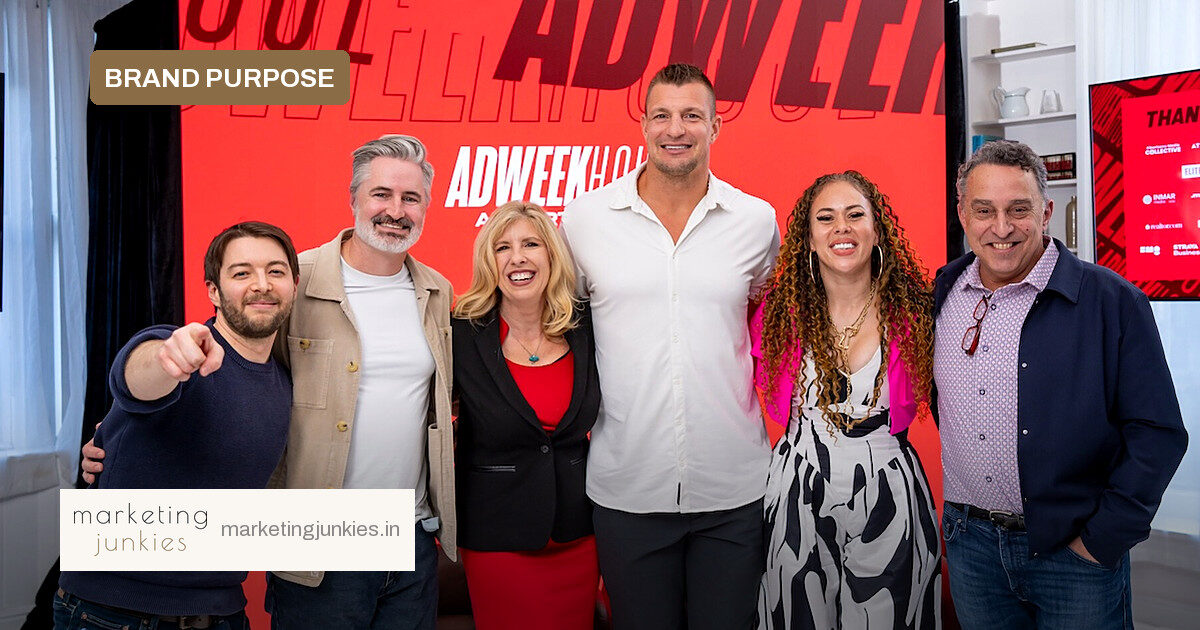
At an ADWEEK House Advertising HQ panel co-hosted with Fluent, a group of marketers and entrepreneurs argued that authentic brand purpose is not a soft metric. It is the mechanism that converts a one-time transaction into long-term customer belief.
Moderated by ADWEEK’s Bill Bradley, the discussion brought together David Young, VP of retail media at DICK’S Sporting Goods; Jeanniey Walden, CMO of Fluent; Perry Kamel, founder and CEO of DNA Vibe; Lois Cook, CEO of FootballHer; and Rob Gronkowski, four-time Super Bowl champion, sports broadcaster and entrepreneur. Their shared message: consumers know when purpose is performative, but they go the distance for brands that actually live it.
What makes purpose credible
Young said effective marketing creates a shared sense of purpose, moving a transactional exchange into an emotional one. “People need to recognize themselves in your message and what you stand for,” he said. For DICK’S Sporting Goods, that means acting on the belief that sports can change lives for athletes of every kind.
Kamel offered a sharper proof point. Earlier this year, DNA Vibe partnered with MoveUkraine to set up a production facility in Ukraine, where a local team assembles and distributes the company’s recovery devices to wounded veterans and civilians receiving care. “How could we not do this?” he asked. “Purpose is extremely powerful. It’s the first thing, but it’s got to be the real thing.”
That distinction matters for marketers. A purpose claim without an operational commitment reads as positioning, not proof.
Trust begins after the purchase
Walden argued that brands should build experiences around their customers and keep supporting them beyond the point of sale. “The transaction is just the beginning of an entire journey that gives you purpose for what we’re all doing every day,” she observed.
That post-purchase lens is where brand belief compounds. “When you create trust, you create belief in a brand,” Walden said. “When you create belief in a brand, that’s where the business grows.”
Cook brought the same logic to partnerships. As CEO of FootballHer and a professional football player, she chooses to work only with brands that share her values. “I have to be credible; there has to be integrity in what I do,” she said.
Prepared to show up
The panel ended with two lessons on what it takes to deliver. Gronkowski, drawing on his NFL experience, said talent alone is not enough. “It doesn’t matter how talented you are in the NFL. If you don’t know the playbook, you’re not going to play.”
Walden’s example tested trust directly. At a cash-strapped startup, the CFO gambled away a client’s media budget. She took out a second mortgage, paid for the media, and launched her own agency the next day with the client in tow. “It’s really important that you show up, and when people put their trust in you, that you be there for them,” she concluded.
For marketing teams, the panel’s advice can be condensed into three practical moves:
- Back the claim: Choose an operational action that proves your purpose, not just a campaign line.
- Design beyond checkout: Map the post-purchase journey and build support, appreciation and community moments.
- Prepare for the pressure test: Have the strategy and resources to show up when trust is on the line.
Source: Adweek