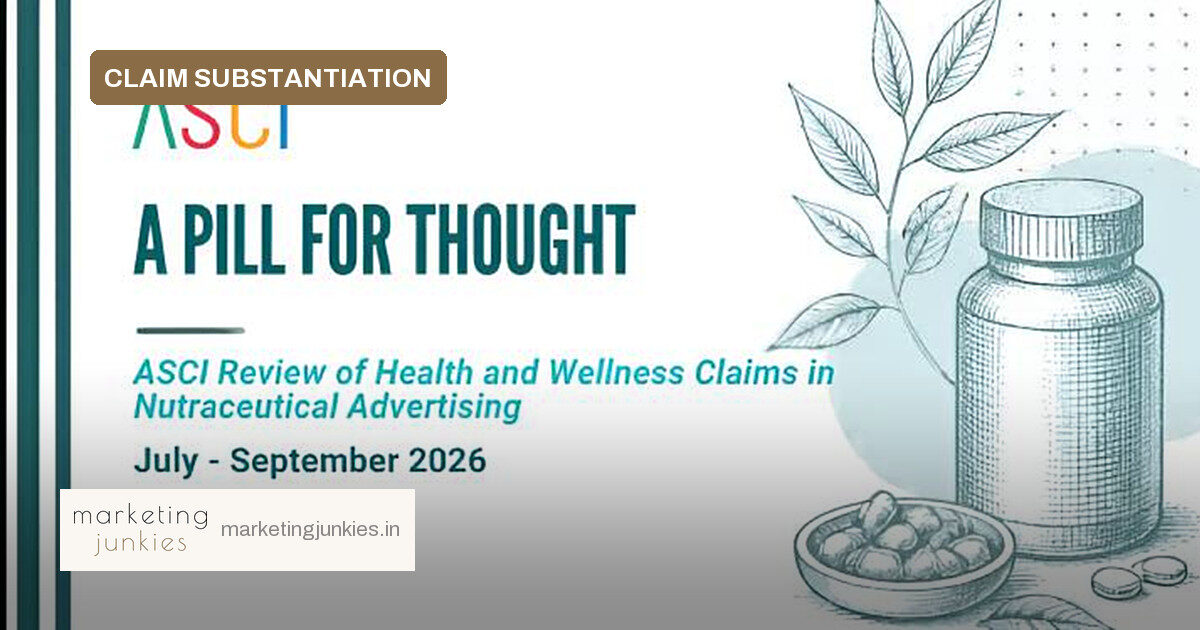
The Advertising Standards Council of India (ASCI) has delivered a stark warning to health and wellness marketers: in its latest nutraceutical advertising review, every completed case failed the code. The suo-motu report, A Pill for Thought, examined ads that ran between July and September 2026 and found that all 60 processed advertisements violated the ASCI Code.
A clean sweep of violations
ASCI assessed 61 advertisements. One is still under process; of the remaining 60, none met substantiation requirements. 29 advertisers did not contest the objections, while 31 did contest but could not provide adequate evidence for their claims.
The claims in question span weight management, anti-ageing, skin lightening, UV protection and respiratory health. Some ads went further, promising help with asthma, COPD, blood pressure, cholesterol and PCOS. Examples flagged in the report included “Lose 6 kgs in 60 days”, “Your thigh fat will be gone in 12 weeks” and “300% stronger skin defence against UV damage”.
Three recurring failures
- No product-level proof: advertisers relied on ingredient research, not finished formulation tests.
- Unsubstantiated superiority: words such as “faster” and “more effective” appeared without a clear or substantiated benchmark.
- Promises beyond evidence: benefits were promised, and several advertisers withdrew or modified ads rather than provide substantiation when challenged.
Manisha Kapoor, CEO and Secretary General of ASCI, said consumers turn to nutraceuticals in good faith. “When advertising promises rapid weight loss, reversal of aging or relief from specific health conditions, the evidence must be strong enough to support those claims,” she said. “Research on an individual ingredient cannot automatically be used to substantiate the efficacy of a finished product.”
Why it matters for a growing category
India’s nutraceuticals market was valued at USD 38.77 billion in 2025 and is projected to reach USD 1,151.5 billion by 2033, according to Grand View Research cited in the report. That scale makes advertising claims more consequential, not less. Misleading visuals and exaggerated outcomes blur the line between general wellness support and medical treatment, creating unrealistic expectations.
The substantiation hierarchy every health brand needs
A practical way to apply the report is to separate three levels of evidence before approving a campaign: ingredient research, finished formulation testing, and product-level proof. Ingredient data can indicate a direction, but only product-level studies or independent test reports can carry a specific outcome claim. Match every line in the creative to the strongest evidence you actually hold.
For marketers, the fix is preventive. Build claim substantiation into the brief, keep product-specific proof on file, and remove before-and-after visuals or quick-result promises that the finished product cannot support.
Source: MediaNews4U