
Generative AI is becoming a front door for product discovery, but a new report suggests that door opens differently depending on where a buyer is, what language they use, and which chatbot they ask.
How the study was designed
FTA Global’s “The Context Report” tested 1,200 identical buying questions across 10 business software and payments categories, covering CRM, project management, payroll, email marketing, accounting, payments, video conferencing, web hosting, cloud storage, and HR and recruiting. The queries ran on ChatGPT and Gemini in 12 cities and seven languages, with each question repeated five times to check for variation.
The main finding: context changes the answer
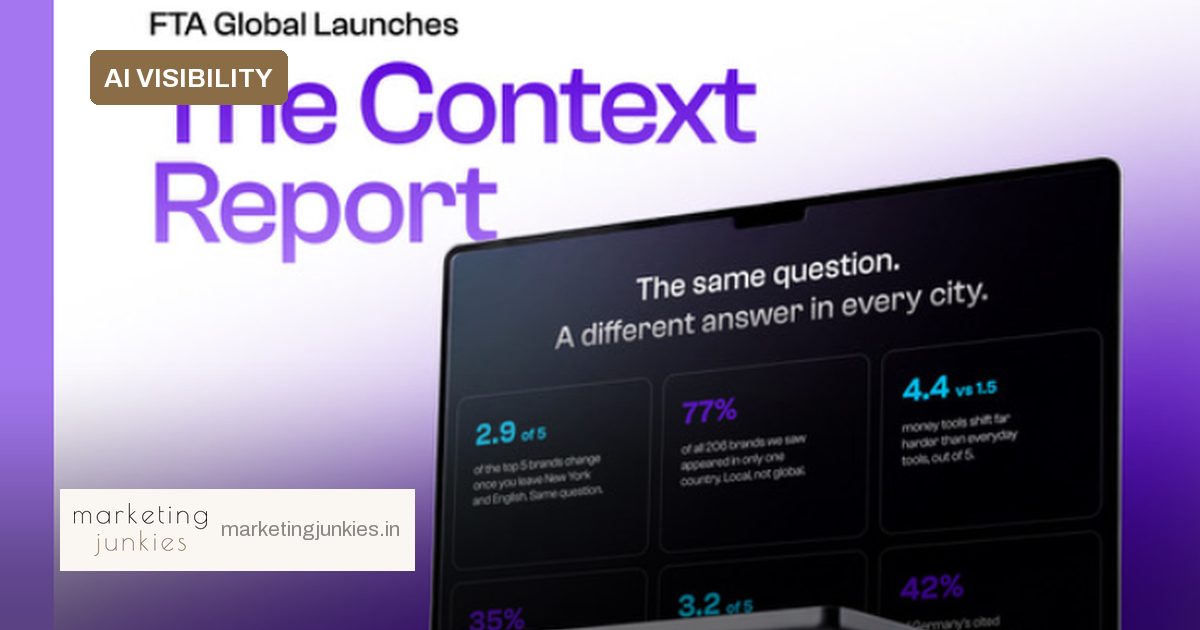
The results challenge the idea that a single AI visibility score can capture how a brand shows up. In the payment gateway category, the same question produced Stripe, Square, and PayPal in New York, but Razorpay, Cashfree, and PayU in Mumbai. The two market-level lists had no names in common.
Across the full study, nearly three of the top five recommended brands changed when the buyer context moved away from New York and English. Of 206 brands identified, 159 appeared in only one country. Money-related categories showed the most geographic variation, with 4.4 of the top five brands changing on average, compared with 1.5 for everyday categories such as video conferencing and cloud storage. In HR software, none of the top US brands appeared in the other countries tested.
Platform and repeat-query inconsistency
Even when city and language were held constant, the two AI platforms disagreed. ChatGPT and Gemini shared only about 3.2 of the top five brands for the same question in the same city. Repeated runs were also unstable: a consistent top brand appeared in only 35% of tests.
Local content showed a clear link. In Germany, 42% of the sources AI cited were German web pages, which points to the value of publishing and optimizing content for the local language and market.
What this means for marketing teams
Rather than chasing one global AI ranking, teams should audit visibility in the contexts where buyers actually evaluate tools. A practical three-part check can help:
- Context: Track which brands AI recommends by city, language, and use case—not just one home market.
- Consistency: Run repeated queries and compare ChatGPT, Gemini, and other AI assistants to see how stable your position is.
- Content: Build and maintain local-language pages that AI systems can cite when answering location-specific questions.
FTA Global has also introduced Context Authority, a metric that measures how consistently a brand appears within a buying moment across relevant cities, languages, and AI environments.
Senthil Kumar Hariram, Founder and Managing Director of FTA Global, framed the shift: “AI is changing the way brands are discovered, but discovery does not happen the same way for every buyer.” The implication for marketers is to stop asking only “are we visible?” and start mapping where, in what language, and on which platform discovery actually happens.
Source: MediaNews4U