
Restaurant chains that are opening outlets look very different online from the ones shutting them — and the biggest difference now sits inside AI chatbots.
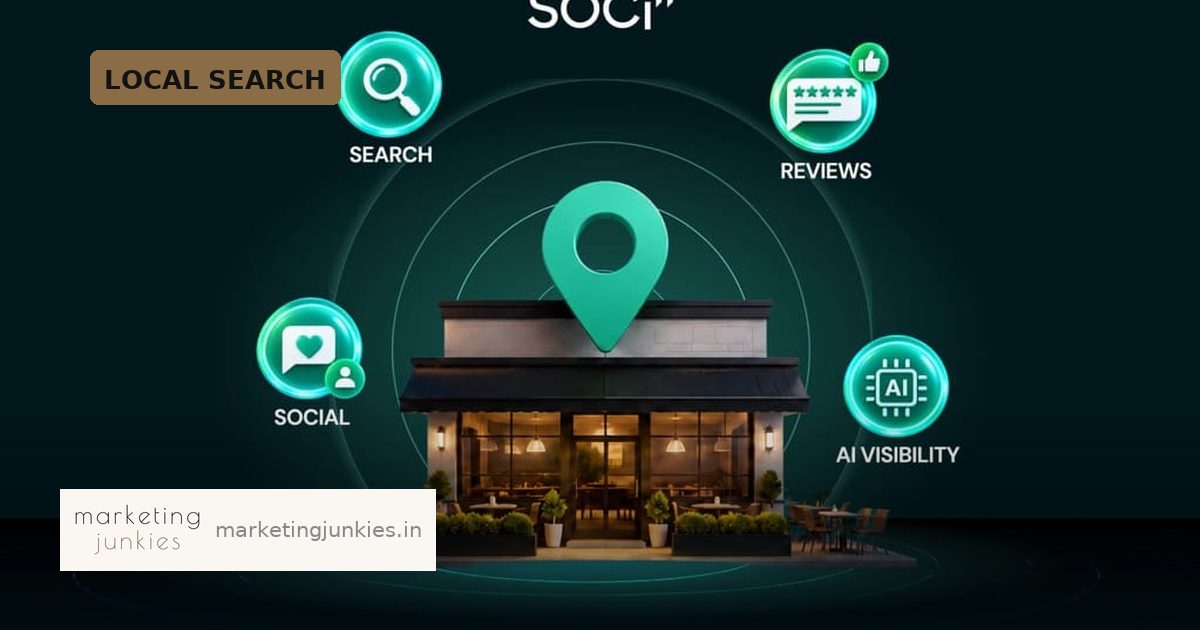
That is the headline from an analysis published on MarTech, authored by local marketing platform SOCi, which compared eight expanding US restaurant brands with eight contracting ones using its Local Visibility Index (LVI). The LVI is SOCi’s own composite 0–100 score built from search rankings, review sentiment, social engagement and AI recommendation rates.
The result: growing brands averaged an LVI of 61.4, shrinking brands 46.6 — a gap of 14.8 points that held up across every channel the company measured.
The context
The piece opens with a familiar 2026 storyline. Culver’s, Texas Roadhouse and Nothing Bundt Cakes have been adding hundreds of locations. Wendy’s, Papa John’s and Pizza Hut have been closing hundreds. Jack in the Box, Red Robin, Denny’s and Red Lobster have also trimmed their footprints.
The usual explanations — economic pressure, menu fatigue, private equity ownership — are not dismissed. But the argument here is that local digital fundamentals appear to move in step with the fundamentals driving real estate decisions, often before the trade press catches on. In other words, treat local visibility data as a leading signal, not a cause.
Where the gaps show up
According to the analysis:
- AI recommendations: Expanding chains were recommended by ChatGPT in roughly 20% of tested queries, versus about 3% for contracting chains — a 6–7x gap. Gemini and Perplexity showed the same pattern, with expanding brands also earning higher AI-assigned star ratings.
- Search: Expanding chains appeared in Google’s local 3-Pack for 35.3% of tracked searches against 14.4% for contracting chains, and held Yelp’s top organic ranking 55% of the time versus 29.3%.
- Reputation: Average Google ratings of 4.39 versus 3.82, and Yelp ratings of 3.65 versus 2.49 — a Yelp gap of more than a full star.
- Review response: Expanding brands replied to 72.4% of Google reviews versus 43.6%, and did so two to three times faster.
- Social: A 3.45% local social engagement rate versus 0.13% — roughly 26x — plus about five times more local followers.
Why AI visibility is the hardest channel
SOCi’s wider 2026 LVI research found AI recommendations are far more selective than traditional search. Only about 1–11% of brand locations get recommended across ChatGPT, Gemini and Perplexity, compared with 35.9% appearing in Google’s 3-Pack.
That selectivity is the point. Getting named by an AI assistant appears to demand cleaner location data, stronger reputation signals and genuinely differentiated content. Strong Google rankings no longer guarantee an AI mention — which makes AI a distinct audit item, not a by-product of SEO.
What Indian marketers can take from it
The dataset is US restaurant chains, but the mechanics travel. Any multi-location business in India — QSR, salons, clinics, gyms, dealerships, retail — runs on the same discovery stack: Google Business Profiles, maps, reviews, local social handles and, increasingly, AI assistants used for “best biryani near me” style queries.
The practical checklist from the article, translated for any local-heavy brand:
- Treat listing data as infrastructure. Complete, consistent NAP data across platforms and store pages underpins every other channel — and it is the first thing AI systems verify.
- Systematise review responses. Coverage and speed separated the two groups more cleanly than star ratings, and it is a lever you can move in weeks rather than years.
- Localise social content. The gap did not come from posting more. The article calls out “waterfall posting” — pushing identical corporate content to every location page — as the losing pattern.
- Test AI visibility deliberately. Run your top 20 category and “near me” queries through ChatGPT, Gemini and Perplexity and log whether you appear at all.
One caveat worth keeping in view: the analysis is sponsored content from SOCi, which sells local visibility software, and MarTech notes it neither confirms nor disputes the conclusions. The correlations are directional, not proof of causation. Still, as a diagnostic framework — search, reputation, social and AI treated as one connected system rather than four separate to-do lists — it is a useful audit template for any brand with more than a handful of outlets.
Source: MarTech