
Swiggy’s growth team is testing whether an AI agent can be handed a raw business objective, reactivation of dormant users, and left to decide the campaigns, timing and messaging that achieve it. Early results shared at the ET MarTech+ Summit 2026 suggest the approach cut volume while holding performance.
The experiment: fewer campaigns, better reactivation
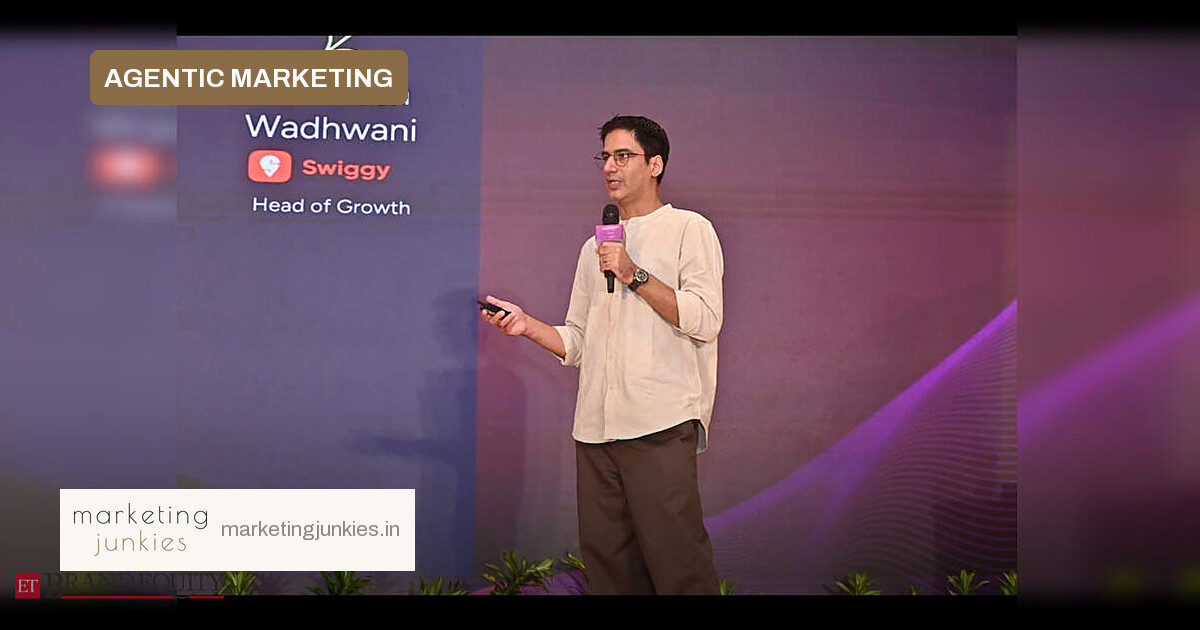
Ashutosh Wadhwani, head of growth at Swiggy, said the agentic marketing test produced 5 per cent higher reactivation of dormant users while using 50 per cent fewer campaigns than business-as-usual (BAU). Instead of applying a uniform campaign frequency, the agent looked at customer journeys, behaviour and engagement timing to choose the next best action.
The shift also reduced push notification load. In the tested base, BAU used three push notifications; the agent reached the same outcome with two. Wadhwani said that could help lower unsubscribe rates, especially since multiple Swiggy businesses compete for attention from the same customer.
Coordination, not just optimisation
The stakes are larger because Swiggy operates more than 27 million monthly transacting users, close to five customer-facing apps and about 11 business teams. It currently runs 6,000-8,000 campaigns across segments and businesses. During peak and festive periods, several teams may try to reach the same customer simultaneously, making coordinated communication more valuable than optimising each campaign in isolation.
AI speeds up campaign building
Swiggy is also using Merlin AI, a customer agent developed with MoEngage, to turn natural-language business objectives into customer journeys. Wadhwani said complex journey build time fell from roughly 1.5 hours to 15-20 minutes, freeing teams to experiment faster. A similar tool, Flow Assist, builds in-app experiences for delivery partners within predefined design and execution guardrails.
Guardrails over autonomy
As campaigns are generated faster, Swiggy uses a campaign QC agent to check execution: deep links, personalisation, do-not-disturb windows and throttling rules. Wadhwani summed up the operating principle as “Guardrails over autonomy.” Teams need to define:
- where an agent can act independently
- where it needs approval
- what counts as a no-go zone
For marketers, the takeaway is that the next phase is not simply automating tasks. The goal is a system that observes customer behaviour, decides, executes, measures and learns, while humans set objectives and boundaries.
Source: ETBrandEquity.com