
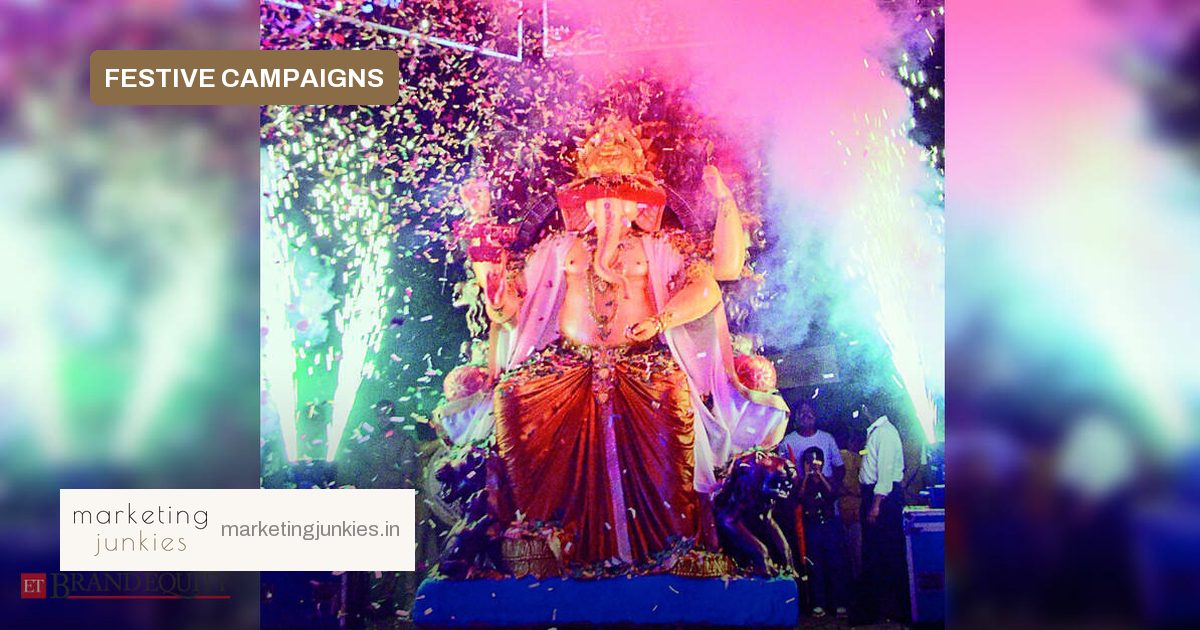
As Ganesh Chaturthi 2026 got underway, brands moved beyond templated festive greetings and used the festival as a creative pressure test. A curated roundup from ETBrandEquity shows how advertisers turned nostalgia, product design, delivery interfaces and payment conversations into distinct Bappa moments.
Nostalgia and everyday objects
Paper Boat returned to a familiar emotional register. Its campaign recreated the childhood experience of visiting festive markets and stopping in front of rows of Ganesha idols, wishing to bring one home. The execution plays to the beverage brand’s long-running emphasis on memory and Indian childhood.
DHL took a more visual route. In its ad, sunlight hitting a cargo plane produces a runway shadow that reads as a Ganesha silhouette. The implication is simple: the most meaningful delivery of the season does not need a tracking number.
Appliance players Croma and Goldmedal embedded their products into the celebration. Croma presented a computer mouse as the tiny vehicle for Mooshak Raj, while Goldmedal used two irons to form the outline of Bappa’s face, tying the product promise to removing everyday obstacles.
Platforms as festive canvases
Blinkit and Domino’s landed on a similar visual idea this year. Both used live order-tracking maps to trace the outline of Lord Ganesha along delivery routes. It is a strong example of turning a functional app screen into a moment of festive storytelling, rather than adding a decorative banner to the side.
Payments brands Visa and Mastercard anchored their messages in the modak. Visa positioned the sweet as a ten-day festive menu, while Mastercard used the ritual of offering the first bite to Bappa to reinforce its familiar priceless territory.
Media and internet brands kept their own voices intact. Discovery Channel suggested Ganesha is present beyond pandals, woven into the world around us. Cartoon Network leaned on animated nostalgia with Jerry whispering a wish into a baby elephant’s ear. Zomato brought internet slang into the festival, treating Bappa as a familiar best friend who makes everything feel like home.
What marketers can take away
The standout ideas share a common feature: the ritual is not pasted onto the brand; it is expressed through a product interface, category cue or established tone of voice. For marketing teams planning the next festive window, the campaigns suggest a short checklist:
- Use a native brand surface—such as a tracking map, product silhouette or app screen—rather than only a greeting post.
- Anchor the story in a specific ritual, whether it is modaks, pandal visits or the arrival of Bappa.
- Keep the brand voice recognizable so the work does not feel like a generic festive template.
- Test whether the idea would still work with a competitor’s logo; if so, it may need a stronger product or tonal link.
Festive periods have become crowded with real-time and planned campaigns. The Ganesh Chaturthi 2026 work is a useful reminder that the most memorable executions usually come from a very simple intersection: a true brand asset and a local ritual that people already feel.
Source: ETBrandEquity.com