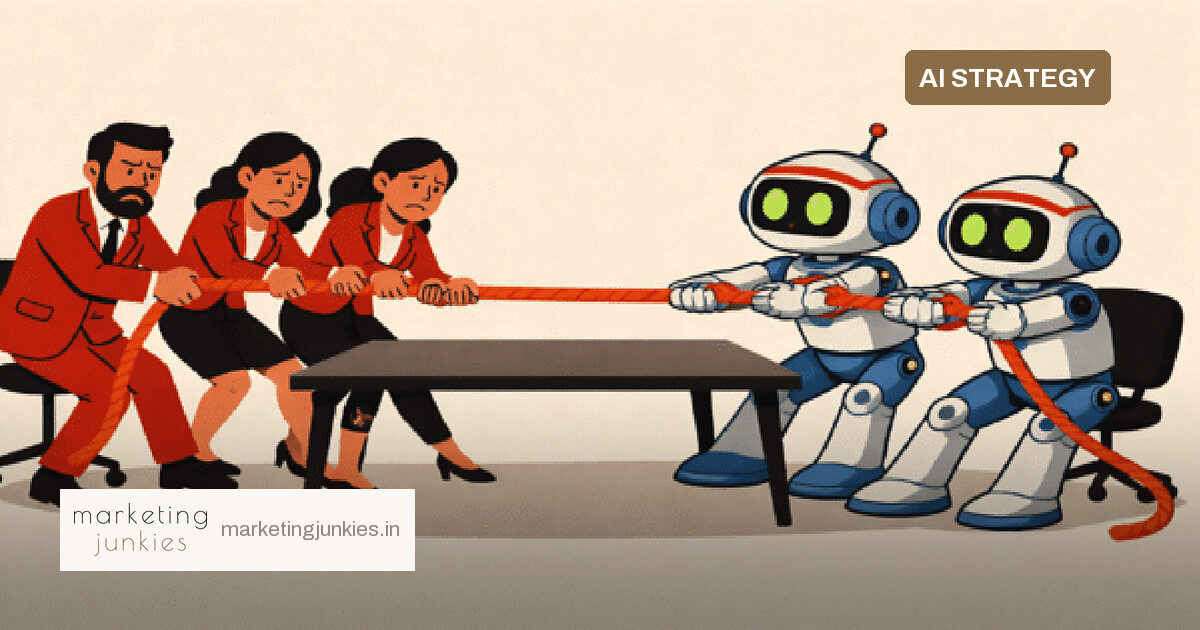
AI has moved from enterprise experiment to everyday marketing utility. It now sits in email service providers, inboxes, martech automations, workflow managers and even personal organisers. But as AI takes on more execution, the marketer’s job is shifting from operator to strategist—and that shift comes with new risks.
The core tension is simple: AI removes the friction between an idea and its execution. That speed can return time for analysis and planning, but it can also push a team down the wrong rabbit hole before anyone notices. The people getting results are adding a strategy step back in, not skipping it.
The promise and the rabbit hole
AI can now handle repetitive tasks and even offer strategic advice. The promise is time: time to spot trends, plan campaigns and set goals instead of just getting work out the door. One practitioner described building an AI-powered insights dashboard that pulls channels together and offers direction from the full picture.
The threat is quieter. Because AI makes it easy to tell a tool what you want and how to do it, teams can launch projects quickly without the proper setup. The mistake only becomes visible after hours are lost. The lesson is to take the planning step people used to skip when they were pressed for time.
When AI says no
Governance is often seen as boring, but it works like guardrails against AI-inflicted damage. A recent example: a marketer asked Claude to perform a task, and the assistant refused. The response was firm:
“The terms and conditions of this website don’t allow me to do that.”
The assistant had read the fine print the user usually ignores. The team found a compliant route instead.
That kind of refusal matters for companies. It can prevent terms-of-service violations, leaks of sensitive information or rogue automated emails. SaaS providers should also take note: many have not updated their terms and conditions for new technology. A product can be technically capable while a stale T&C quietly blocks what customers want to do.
MCPs are the new must-ask feature
MCP stands for Model Context Protocol. In plain terms, it is a bridge that lets an AI model connect to external databases and other resources. For marketers evaluating platforms, the MCP is quickly replacing the API as the must-have integration feature.
Buyers are now asking vendors sharper questions in RFPs:
- Do you have an MCP?
- What is the functionality?
- Is it headless?
- What experience can I expect when I plug my AI into your platform?
- How easily can I import and access data?
- What controls do you use?
If the answer is thin, the platform often gets dropped. The same applies to websites being considered for development: no visible MCP can mean an instant exit.
What to do next
Marketers are no longer leaving technology questions to IT. They are taking an active role in platform selection and having informed conversations with vendors. That participation is what separates teams that keep pace from those watching technology race ahead.
Three habits can help:
- Build the strategy layer before you prompt, even when execution feels urgent.
- Add MCP questions to every vendor shortlist and treat vague answers as a red flag.
- Treat an AI “no” as a learning signal, not a personal rejection.
The playbook is changing, but the end goal remains the same: right channel, right message, right time. AI may finally make that promise feel closer—provided marketers stay engaged enough to steer it.