
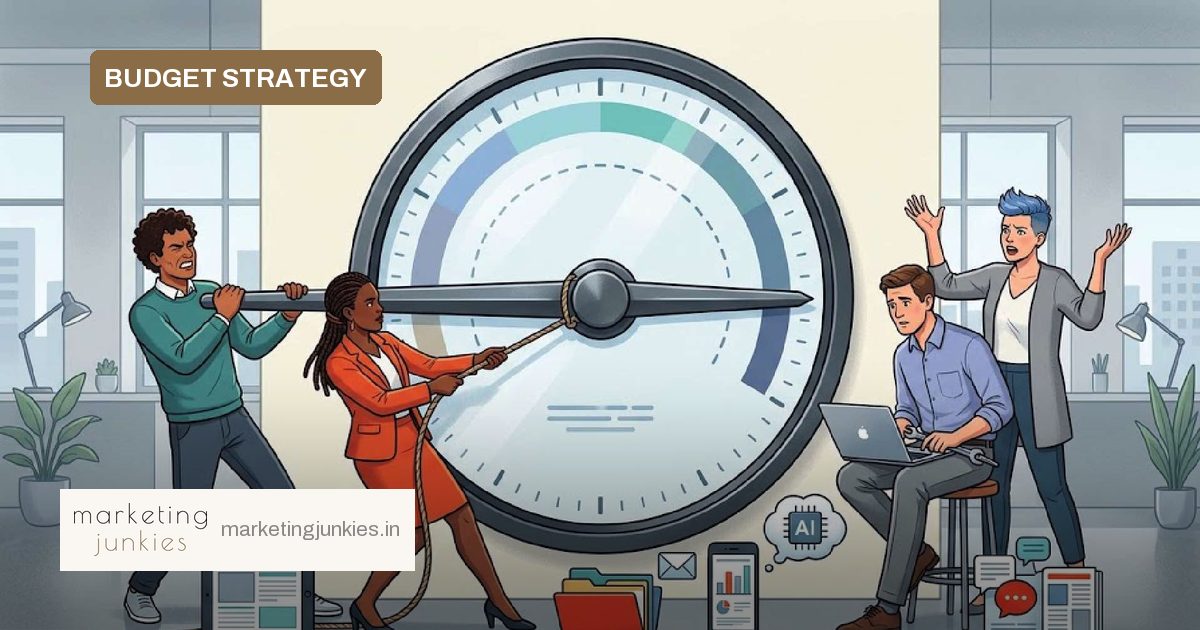
A flat marketing budget may look stable in the boardroom, but it functions like a cut. When CPMs, CPCs, CACs and inflation rise, the same allocation buys less reach, less traffic and fewer customers every quarter. For CMOs heading into 2027 with budgets unchanged from 2026, the pressure is familiar: boards still expect growth, but the purchasing power behind that growth is shrinking.
The long-term risk is easy to miss. Imagine a farm that stops planting. For months, the operation appears healthy. Existing crops mature, the harvest comes in and revenue lands as usual. The problem appears the following year, when there is nothing new to harvest. Flat marketing budgets work the same way: demand generation can coast for a while, but future pipeline quietly thins.
Protect what works without over-cutting experiments
The immediate response should be to protect lower- and mid-funnel programs that are already producing. That usually means upper-funnel activity takes the hit. It can be a valid short-term move, but finance-friendly cuts are not a long-term growth strategy.
One trap is turning off every experimental campaign. They rarely offer revenue guarantees, so they can feel risky in a budget squeeze. This instinct is not purely rational. It reflects loss aversion, the bias made famous by Kahneman and Tversky. In a classic study, people who faced a 50/50 chance of winning or losing $100 wanted around $200 in potential upside before accepting the gamble. The fear of a loss can outweigh a similar gain, which leads marketing teams to pass up profitable tests just when adaptability matters most.
Find savings in vendors, platforms and agency models
Before cutting further into demand-generating work, audit the operational layer. Even a modest review can free up funds:
- Can overlapping software platforms be consolidated, or unused licences and legacy tools removed?
- Can contracts be renegotiated to reflect current usage?
- Can more work move to an agency, or can AI reduce the need to backfill a role?
If flat budgets have persisted for several years, these small fixes may already be exhausted. At that stage, incremental optimization is no longer enough, and structural change becomes necessary. AI should be used aggressively for workflow automation and content creation. Agency relationships also need a closer look.
For some teams, an agency can bring capabilities, technology and experienced talent at a lower cost than building in-house. For teams already using agencies, the old playbook of simply bringing everything in-house is not automatically better. A 2026 ANA report makes the point that there is no one-size-fits-all approach to in-housing. A useful comparison weighs total value: agency fees against discounted rates, value-adds, platforms, shared talent and team experience. Contract structures can also be negotiated so both sides benefit.
Reframe marketing as a growth multiplier
After multiple flat years, the most important work is to change the conversation. Partner with analytics to quantify market-share risk from underfunding. Show how rising customer acquisition costs are linked to constrained budgets, and use that data to make the case for future investment.
The goal is to ensure marketing is seen not as a cost center but as a growth multiplier. Without that shift, the budget line may stay flat while the underlying business quietly loses its next harvest.
Source: MarTech