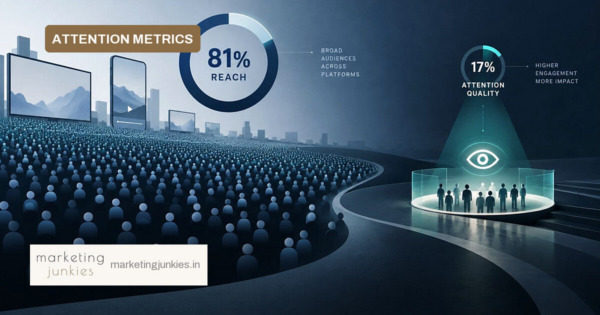


Indian media planning still leans heavily on reach, but a new industry report suggests attention quality is being left out of the equation. The Beyond Reach report finds that 81% of Indian marketers continue to prioritise reach, while only 17% put attention quality first.
Reach still dominates the plan
The report asked marketers how attention shows up in their day-to-day media decisions. The gap is wide:
- 69% either do not include attention in their media plans or do not use it to inform decisions.
- 86% say they would be likely or very likely to shift budgets if reliable attention data showed a different allocation could build stronger brand memory.
- 92% rank the lack of reliable or standardised attention measurement among their top three challenges.
- All respondents said an agreed industry standard would accelerate adoption.
That combination — high intent, low adoption — is the most telling part of the study. Marketers are not rejecting attention metrics; they are waiting for a measurement framework they can trust and compare.
Measurement is the bottleneck
Attention may be a popular topic at industry events, but it has not yet become a practical planning input. The report points to standardisation as the missing piece. Marketers want a common currency for attention, the same way they have established currencies for reach and viewability.
Lalatendu Das, CEO, Publicis Media South Asia, said reach will remain fundamental to media strategy, but scale alone does not show whether an exposure has the quality or opportunity to drive an outcome. He added that the opportunity is to make attention thinking practical, measurable and actionable in media investment and optimisation.
Creative adaptation is lagging
There is also a disconnect between what marketers believe and what they do. While 94% said creative was at least as important as media placement in earning attention, only 14% said they systematically adapted creative to different formats and lengths.
That is a signal for agency and brand teams: media planning and creative execution are still being run separately. If attention is the goal, format and length decisions should shape creative, not just media placement.
Why this matters for Indian marketers
Reach tells you how many people could have seen an ad. Attention starts to tell you whether the exposure had a chance to register, build memory and influence brand choice. For a market where media is fragmented across TV, digital, retail and regional platforms, that distinction matters.
Moneka Khurana, Managing Director, MMA India, put it simply: ‘being seen is not the same as being noticed.’ Marketers need evidence they can trust and compare. The report argues for adding attention alongside reach when decisions are made about placement, format, frequency, creative and budget.
What to do next
A practical first step is to build a reach-plus-attention planning grid. Score each channel or format on both dimensions, then test budget shifts where attention data shows stronger exposure quality. Creative teams should also move from one-size-fits-all assets to format-specific versions.
None of this replaces reach. It qualifies it. The report’s conclusion is clear: attention measurement can help marketers assess the quality of advertising exposure, but standardisation and deeper integration into media planning need more work.
Source: The Economic Times