
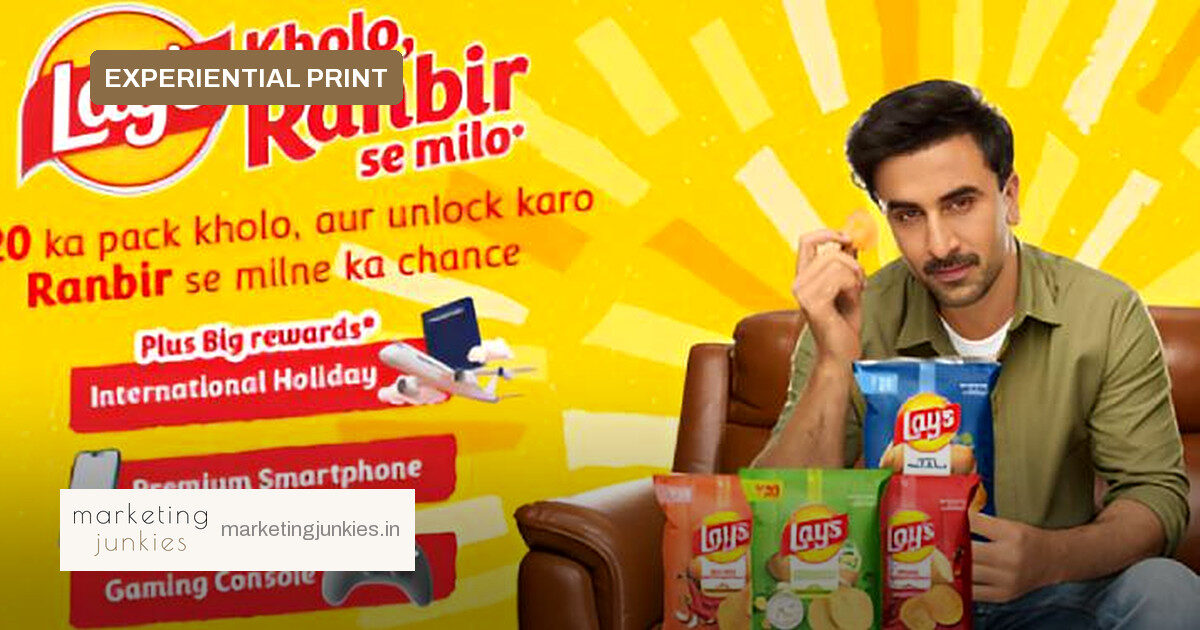
Lay’s has taken its “Lay’s Kholo, Ranbir Se Milo” promotion into the newspaper with a format that asks readers to do something instead of just look. As reported by MediaNews4U, the print ad uses a peel-and-reveal mechanic: a reader peels back a section of the advertisement to reveal an image of themselves sitting alongside actor Ranbir Kapoor. One page turn later, the same execution serves up contest details, entry information and the rewards on offer.
How the execution works
The creativity sits in the sequence. The first interaction is tactile—a peel, not a scroll. The second interaction is a page turn that moves the reader from surprise to next step. The third moment is at the shelf, where the visual idea continues on Lay’s retail racks. That chain turns media exposure into a guided path toward the product and the promotion.
This is not a QR-code-only print idea, and it is not a passive celebrity endorsement. The ad format itself becomes part of the campaign, so the newspaper is no longer simply a canvas for the message; it is the mechanism that carries the consumer toward the offer.
Why this matters for marketers
- It creates a micro-commitment. A reader who peels the layer has already accepted a small invitation to participate.
- It shortens the distance to action. Contest details appear immediately after the reveal, not in fine print elsewhere.
- It connects media and retail. The same visual system on racks gives the newspaper moment a shopper-marketing payoff.
Print often gets briefed as an awareness layer with soft accountability. This execution reframes it as a participation device. For a snack brand selling through high-frequency, low-consideration purchases, the objective is less about informing and more about triggering a fun, memorable interaction that can work alongside the main consumer promotion. The approach also works as earned media: an unusual print ad gives trade press and social users a reason to talk about the campaign, extending reach beyond the paid insertion.
What to borrow
The campaign is a useful template for offline engagement. Marketers can adapt the logic without copying the mechanic. Start with a simple physical action that fits the medium—peel, scratch, tear or fold—then place the next step one action away. Use a celebrity or reward only as the pull, not the whole idea. Finally, extend the same creative system into retail so media and point of purchase read as one story.
The deeper lesson is that interactive ideas do not need a screen. When the format and the offer are tied together, a newspaper page can do what many digital ads fail to do: earn a physical moment of attention and move a consumer one deliberate step closer to purchase.
Source: MediaNews4U