
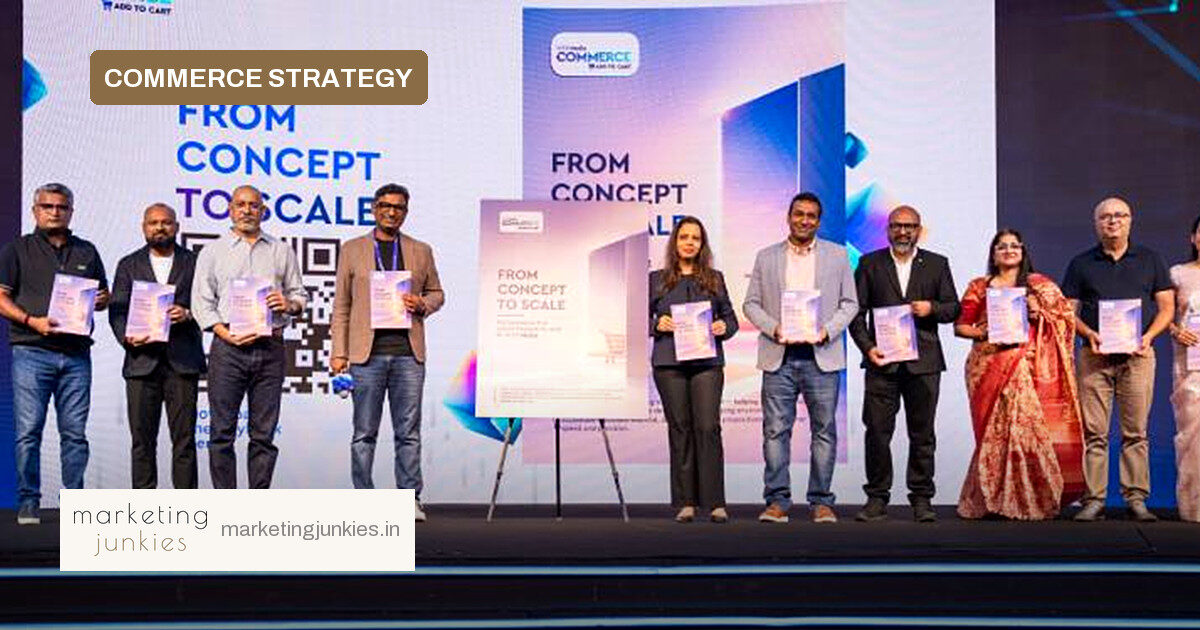
WPP Media India has released a new report that urges brands to treat e-commerce platforms as launch environments rather than mere sales channels. Titled From Concept to Scale: The Commerce-First Launch Playbook for India, the playbook argues that commerce platforms can now support demand discovery, product validation and brand scaling before a wider offline push.
The report arrives as Indian e-commerce matures: quick delivery, non-metro shoppers and retail media are changing how products find their first buyers. The central message is that brands can learn earlier by reading real shopper behaviour.
Quick commerce becomes a learning channel
Short delivery windows have turned quick commerce into a testing ground for impulse-led purchases. The playbook points to 10-to-20-minute delivery as an accelerator of product trial and feedback cycles. In 2025 quick commerce accounted for 16–17% of India’s e-commerce gross merchandise value, and a Bain & Company and Flipkart projection cited in the report suggests it could contribute 45–50% of incremental e-retail GMV through 2030.
For marketers, that means quick commerce is not just an additional sales route. It can shorten the distance between a launch and early signals such as trial, reviews, repeat purchases and abandonment.
Non-metro India is adding the shoppers
The playbook highlights a geographic shift that many launch plans still underweight: Tier 2+ cities brought in approximately 65% of new e-retail shoppers during 2024–25, according to WPP Media India. With about 90% of Indian retail still offline, the report suggests digital demand validation can work as a proof layer before brands commit to general trade, modern trade or specialised retail.
Rather than blanketing the country, brands can use digital channels to identify high-potential cohorts and pin codes, then prioritise distribution where repeatable demand already exists.
A launch operating system, not just a report
To make the approach operational, WPP Media India has introduced a 90-day gated launch system, commercial health guardrails, a quick commerce entry framework and seven core questions for commerce leaders. The idea is to move from concept validation to repeatable omnichannel scale with tighter controls.
“The opportunity is not simply to launch faster, but to learn earlier, activate smarter, and scale with greater precision,” said Ashwin Padmanabhan, COO, WPP Media South Asia.
Sairam Ranganathan, Head of Ecommerce, WPP Media India, added that the future of product launches in India is “decisively commerce-first,” with platforms evolving beyond points of transaction into environments for discovery, trial, conversion and learning.
Why this matters for marketing teams
Instead of relying on traditional market research alone, the playbook suggests using behavioural signals—product discovery, clicks, consideration, abandonment, trial, reviews and repeat purchases—as actionable feedback. That is a meaningful shift for launch planning: it treats early commerce data as evidence for bigger distribution bets.
- Start with a gated, time-bound launch to test proposition and price.
- Let discovery, trial and repeat-purchase data guide wider distribution.
- Use quick commerce for fast feedback, but validate before offline expansion.
The report’s value is less a single prediction than a discipline: launch to learn, then scale where demand is already visible.
Source: MediaNews4U