
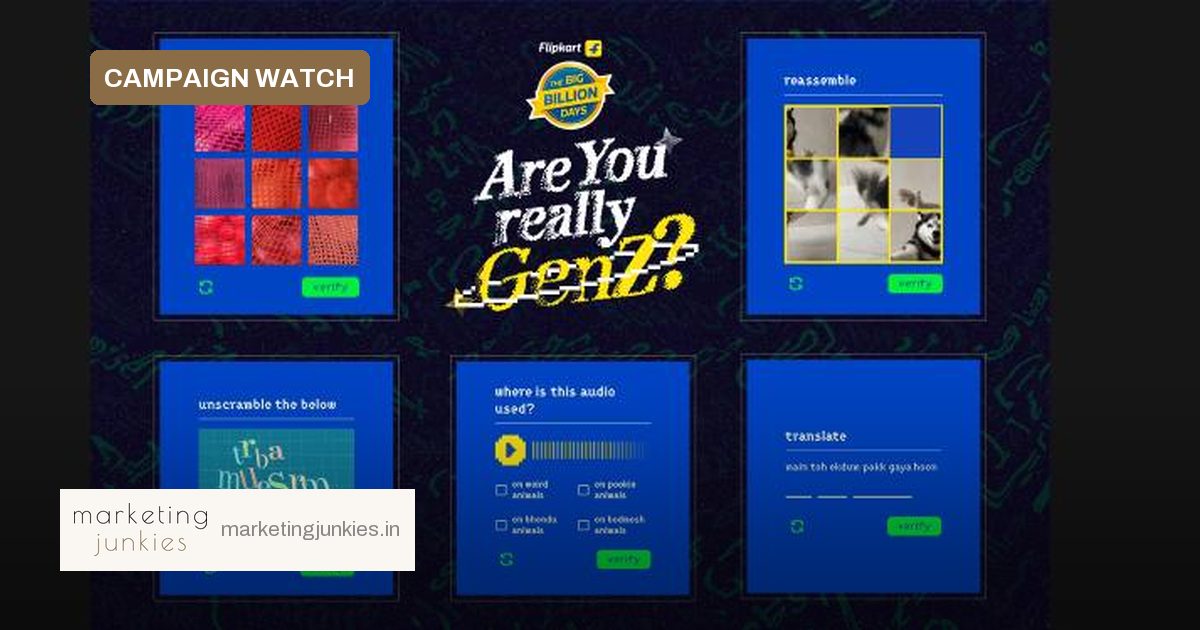
Flipkart and McCann India have turned the run-up to Big Billion Days into a cultural credential check. The new campaign, “Are You Really Gen Z?”, asks shoppers to prove their fluency in Gen Z internet culture before unlocking exclusive fashion and beauty offers.
The campaign is built on an observation many young consumers will recognise: Gen Z slang, memes and visual cues are now so widely borrowed that they often feel forced. The film places phrases such as “rizz”, “cooked” and “no cap” in awkward, out-of-context situations, and lets the reactions of Gen Z characters carry the humour. Viewers are then directed to AreYouReallyGenZ.com.
Three steps to the offer
Instead of a standard discount code, Flipkart is using CAPTCHA-style questions as the entry point. Users must clear three stages that test cultural knowledge across fashion, beauty and internet behaviour. Those who pass can unlock Big Billion Days offers tied to Flipkart’s Gen Z fashion and beauty range.
- The test borrows a familiar format but replaces the usual distorted text with cultural prompts.
- Fashion and beauty offers are positioned as rewards for genuine cultural fluency.
- The experience is live across digital and social channels through the sale period, which begins on October 9, 2026.
Why it matters
This is not just a festive-sale film. It is a participation mechanic that makes the audience the keeper of the culture. Rather than simply adopting Gen Z expressions in advertising, the campaign makes the ability to recognise and use those cues the key to a reward. That can feel more respectful to a generation that is quick to call out inauthentic brand behaviour.
For marketers, the campaign is a useful case in earned access. The sale offer is the functional pull, but the test is the memorable brand layer. When access is gated behind a small challenge, users tend to perceive the reward as more valuable.
The framework in practice
A campaign like this works when the gate feels specific to the community, the reward is desirable, and the tone stays playful rather than patronising. If any of those elements slips, the friction can outweigh the fun.
- Do keep the challenge light and culturally accurate.
- Do link the reward directly to the community’s interests.
- Do use humour to soften the exclusion.
- Don’t make the test so hard that users abandon it.
- Don’t force slang that feels disconnected from the actual audience.
What to watch
The campaign will need to sustain interest through the full Big Billion Days window. A curiosity-driven test can generate strong first visits; converting those visits into repeat shopping behaviour will be the sterner test. Still, in a crowded festive season, the idea gives Flipkart a differentiated campaign asset and a reason for younger shoppers to engage before the sale formally opens.
Gagandeep Bindra and Rahul Arcot, Group Creative Directors at McCann India, said the team set out to give “the actual Gen Zs something only they can experience.”
Source: MediaNews4U