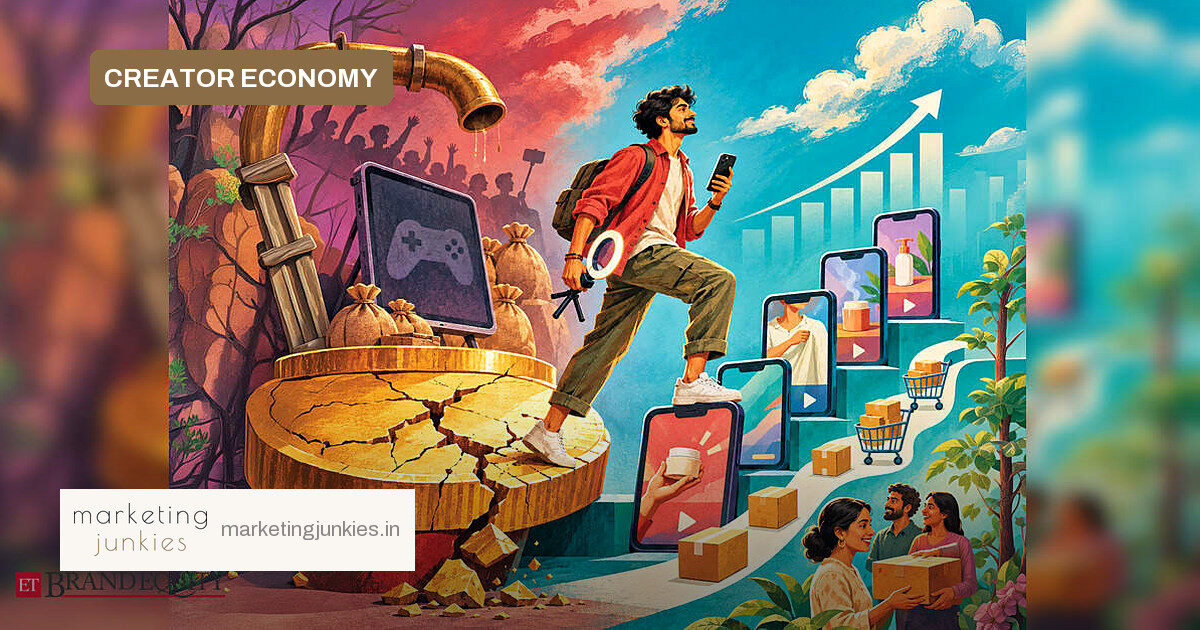
For years, India’s top influencers could almost name their price. Real-money gaming (RMG) platforms competed aggressively for digital real estate, paying premium rates for exclusive long-form integrations and title sponsorships. That money inflated creator valuations across the board. A market correction has now changed the mechanics of the creator economy.
The end of the mega sponsor
As RMG platforms scaled back their sponsorship cycles, the creator economy lost its most lucrative advertiser. D2C brands inherited the primary advertising role, but they are far more careful with budgets. They do not hold venture funds to sponsor vanity projects, and they measure success in sales rather than impressions.
That shift has forced even top-tier creators, who previously refused to negotiate, to recalibrate their rate cards. The period of loose capital and high-overhead sponsorships has given way to an era of unit economics.
How a typical budget is changing
The practical difference is visible in a Rs1 crore marketing budget. Earlier, a brand might have spent the entire amount on two long-form YouTube integrations with a top creator. Today, marketers are splitting that budget across short-form formats such as Instagram Reels and YouTube Shorts.
Short-form execution brings lead times down from weeks to days. If a piece of content underperforms, the financial exposure is small, so the brand can quickly kill the angle and double down on what converts.
What creators are doing to adapt
- Lowering baseline rates or accepting performance-linked bonuses.
- Running leaner operations by downsizing production crews and favouring creators who can shoot, edit and publish independently.
- Taking volume deals for short-form work instead of waiting for rare long-term retainers.
From impressions to conversion proof
In the valuation phase, influencer success was measured through top-of-funnel reach, impressions and brand awareness. The performance phase now relies on direct link clicks, promo code redemptions and verifiable return on ad spend.
The correction is best understood as a move from a valuation mindset to a performance mindset. The valuation era prioritised reach over relevance, high production values over direct response messaging, and high impression counts without downstream conversion tracking. The performance era prioritises bottom-of-funnel sales, dynamic creative testing, clear calls-to-action and sustained conversion rates.
Creators whose value was built on passive views are finding renewal harder, while creators who can explain how they drive conversions are being rewarded.
Why this matters for marketers
Dheeraj Jorwal, founder of Brandzup Media, summarises the new role of creators: “creators are no longer viewed merely as digital billboards, but as dynamic content labs capable of delivering measurable business outcomes.”
For marketing teams, this correction is an opportunity to build a more accountable influencer programme. Test short-form creators with a limited budget, ask for conversion data before signing bigger deals, and connect part of the fee to performance. Creators who understand how to convert audiences are now the most investable partners.
The contraction should not be mistaken for a shrinking market. It is a maturation that removes artificial price inflation and pushes brands and creators toward sustainable models anchored in ROI. That is a healthier base for the next phase of India’s creator economy.