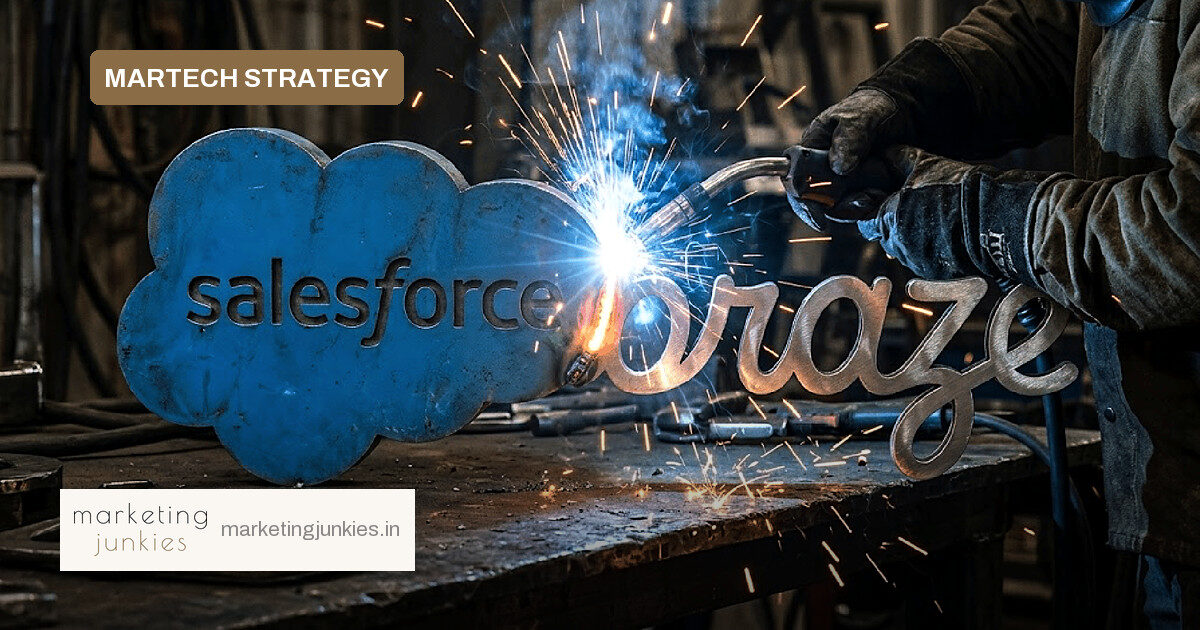
Salesforce’s acquisition of Braze is less about owning more customer data and more about acting on it faster. That is the read from Gartner analysts after the deal, and it signals a cleaner split between the composable CDP era and what comes next.
Braze brings real-time, mobile and app-centric execution to Salesforce’s customer engagement stack. The strategic value, Gartner says, is no longer simply holding a unified customer profile. It is responding at the moment intent becomes clear.
A faster path from data to action
Salesforce already has multiple journey orchestration and activation options. What Braze adds is a shorter route from decision to message across mobile and app channels. That matters because each extra handoff in a composable stack — from warehouse to audience builder to decisioning tool to sender — adds latency and can distort customer context.
Gartner VP Analyst Benjamin Bloom framed the shift bluntly: “Composability is now table stakes in the CDP market. The frontier is the Embedded CDP.” Gartner expects 80% of net-new enterprise CDP deployments to be embedded in, or composable with, enterprise data platforms by 2030.
The overlap problem is now a planning problem
Braze gives Salesforce more depth, but also more overlap. Customers already see activation capabilities across Marketing Cloud Engagement, Marketing Cloud Next and Data 360. The question of where journey logic lives, which platform decides, and which one sends the message now becomes a governance problem.
Gartner expects Salesforce to retire one of its four marketing execution engines by 2029, which would force more than 30% of affected customers into unplanned replatforming. That is a forecast, not a stated roadmap, but it argues against assuming today’s product lineup stays intact.
Pricing and the lock-in test
Braze prices mostly around engaged profiles and message volume, with Action Credits for some activities. Marketing Cloud Next and Data 360 lean more on consumption credits. Salesforce has not said how Braze pricing will change. If Braze moves toward consumption pricing, Bloom says predictable contract terms are replaced by financial risk tied to runtime behaviour that marketing teams must actively govern.
That risk rises when AI agents start triggering campaigns, moving audiences and calling services without a human clicking run each time. Bloom calls for a Marketing FinOps discipline around consumption-priced systems.
What marketers should do now
- Keep at least one independent orchestration vendor in major evaluations and renewals.
- Ask whether a candidate system can run on your existing warehouse instead of forcing a new customer profile store.
- If you are a Braze customer happy with current terms, consider extending them before the deal closes.
- Build cost visibility for agent-driven actions now, before consumption pricing becomes the default.
The most useful way to read this deal is as a path from customer data to customer action that Salesforce has bought. There is clearly value in that connection. The task is to make sure the path also has an exit.
Source: MarTech