

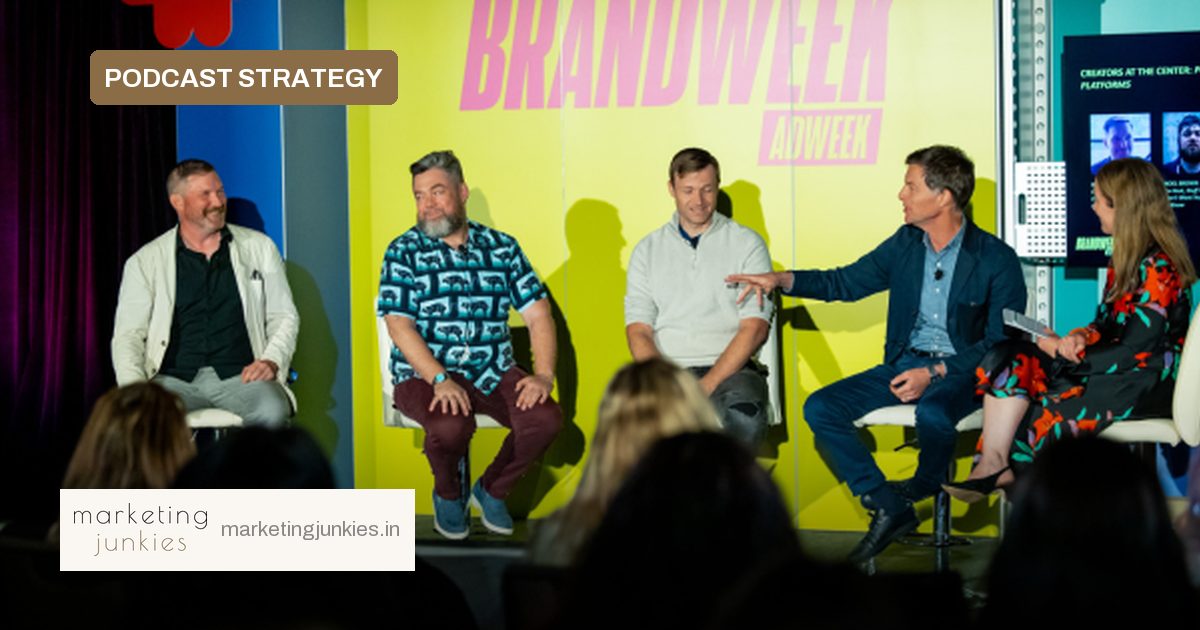
With more than 2,000 episodes behind them, the team from Stuff They Don’t Want You To Know has turned curiosity-driven topics into one of the most durable runs in podcasting. At Adweek’s Brandweek, hosts Ben Bowlin, Noel Brown and Matt Frederick joined iHeartMedia CEO Conal Byrne to unpack what it takes to keep a show relevant for more than a decade.
The backdrop makes the longevity notable: podcast platforms now list more than 4.7 million shows. The program originated from the 1998 launch of How Stuff Works, became part of Stuff Media, and was acquired by iHeartMedia in 2018 for a reported $55 million.
For marketers, media planners and creators, the conversation offered a useful lens on audience-building in fragmented channels. Here are five lessons that stood out.
Five lessons for an enduring podcast franchise
- Treat every idea as worth testing.
- Let the audience shape the content.
- Pair hard metrics with gut-level judgment.
- Keep evolving across formats and platforms.
- Keep human conversation at the centre.
Ideas need room to fail
Bowlin said the show benefited from an early podcasting era with no fixed formula. The hosts were encouraged to try almost anything. That experimental mindset kept the pipeline open and reduced the fear of a weak episode.
Audiences are co-creators
Listener mail has long been a staple, but the team described something deeper: a reciprocal relationship where listeners add expertise the hosts don’t have. Brown gave the example of a recent episode on nuclear weapons, during which a listener who had actually been responsible for launching them described the reality of that world. The takeaway for content teams: audience feedback isn’t just engagement; it can become source material.
Data isn’t the only metric
Byrne tracks cost, sales, downloads and margins closely. But Frederick said he still asks simpler questions after listening to an episode: whether it felt good, moved well and went in interesting directions. Bowlin’s core question is whether the team is excited to do it again tomorrow. That balance of performance data and creative signal is useful for any content program.
Evolution equals survival
Byrne linked the show’s longevity to format flexibility. It began as a video podcast before the term was widely used, became an audio show, had a YouTube run and is now a major video podcast on Netflix. For creators and brands, that means treating distribution formats as changeable, not fixed.
Humans still want messy human content
Recent iHeart research found that although 60% of people routinely use AI tools, more than 90% of listeners don’t want AI-created content. Byrne said the team had once wondered if they should step aside for machines, but audiences made clear they still want organic, imperfect human conversation. That has implications for marketers scaling content with generative AI: use it for efficiency, but preserve the human voice.
For marketing teams, the lessons point toward a simple framework: build a community feedback loop, test formats before doubling down, and measure both performance and creative energy. Shows that last tend to treat their audience as collaborators and their formats as flexible.
Source: Adweek