
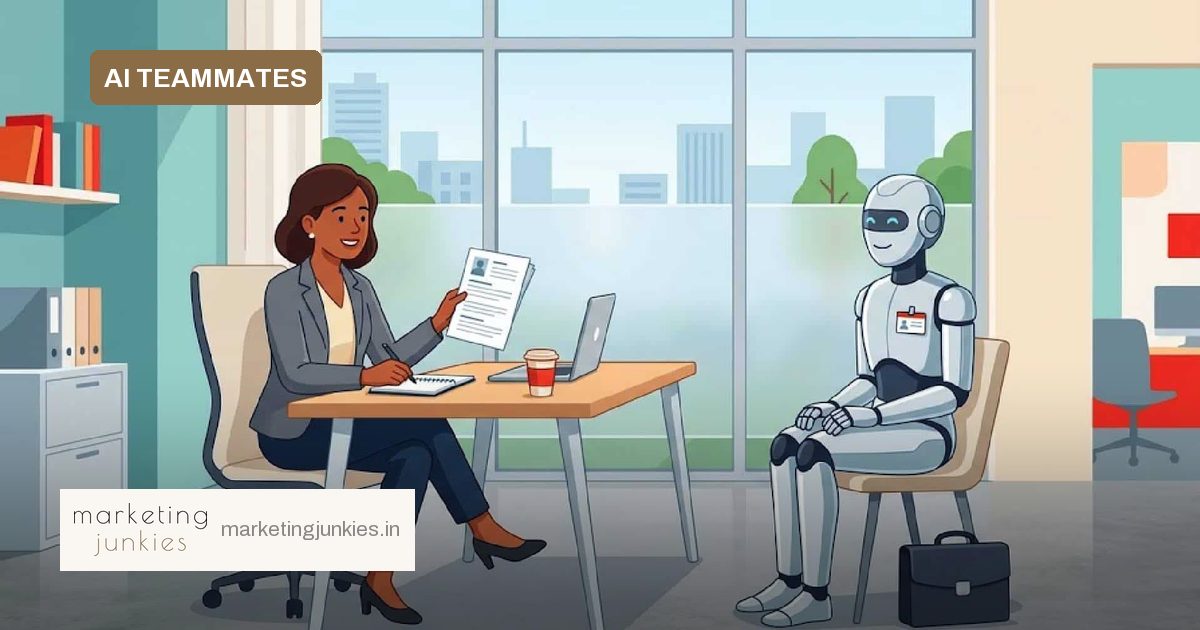
Marketing leaders planning 2027 headcount and budgets are facing a new variable: AI-enabled roles that sit on the org chart alongside people. Vendor announcements from Optimizely, HubSpot, Asana and others signal a category forming around virtual teammates with identity, permissions and audit trails.
From tools to virtual coworkers
Optimizely introduced Virtual Teammates at its 2026 Opticon conference with a directory-style interface and roles including chief of staff, SEO and AI search analyst, marketing analyst, personalization strategist, and CRO manager. Each agent has its own identity and permissions, can run on a schedule or trigger, maintains context across projects, and includes an audit trail.
Other platforms are converging on the same architecture. Treasure AI released a Marketing Super Agent that orchestrates other agents inside a governed workspace. HubSpot shipped more than 20 Breeze agents and calls them digital teammates. Asana offers role-shaped AI Teammates, including a Campaign Strategist, with the human team holding permissions and data access.
That convergence matters: when vendors align on a common model, a category is taking shape. Marketing leaders should expect virtual teammates to be part of the 2027 planning conversation.
Decide what to delegate before buying
Procuring an agentic platform is not like buying ordinary software. The pre-purchase phase should resemble defining a job role before hiring a human. Start with management style: path-based management specifies every step, while goal-based management sets intent and guardrails and lets the agent find the route. For example, lift mid-market SQL conversion 15%, hold brand sentiment at 4.0 or better, and never touch an account with an open Tier 1 ticket.
Assess every candidate task with three questions:
- Is it reversible? Low-risk, undoable work can tolerate real autonomy; irreversible or trust-sensitive work needs review.
- How is output reviewed before customer contact? Be intentional about who checks the work before it reaches a customer.
- What happens when two agents disagree? A pricing agent and a retention agent can chase competing objectives, so decide in advance who wins.
The same role title can demand different autonomy levels. An AI marketing analyst turning data into easy decisions can have more autonomy, while a personalization strategist that codes, tests and deploys live campaigns needs higher scrutiny—even when the two sit in the same folder.
A methodical sequence helps: stabilize, standardize, then automate. As the MarTech article puts it, “velocity on a fragmented operating model mostly means faster entropy.”
Governance and measurement
Large consultancies are already shifting incentives. EY announced a $100 million rewards program for employees who demonstrate critical thinking alongside AI tools, with team awards ranging from $10,000 to $25,000 and individual spot awards topping out at $500. KPMG is reimagining its audit intern program around critical thinking, and PwC is teaching AI proficiency alongside empathy and innovation.
Gartner estimates that over 40% of agentic AI projects will be canceled by the end of next year because of escalating costs, unclear ROI, and a lack of governance over risk. It also estimates that roughly 130 vendors are building truly agentic capabilities into their platforms, while others are relabeling assistants, chatbots and RPA workflows. That makes careful evaluation essential.
For teams that do adopt agents, one human leader can manage a small number of specialized agents grouped by outcome rather than channel. That leader validates agent logic for drift, defines inherited context, arbitrates conflicts, runs sandbox testing before live access, and can hit the kill switch.
Measurement should be agreed before kickoff. Agent utilization and the percentage of campaigns completed can become vanity metrics. Define how incremental value, cost, complexity and governance will be judged, rather than assuming measurement can be figured out later.
The 2027 org chart
Gartner also forecasts that 33% of enterprise software applications will include agentic capabilities by 2028, up from less than 1% in 2024, and that at least 15% of day-to-day work decisions will be made without human intervention. That is roughly one routine decision in seven, creating a design challenge marketing leaders can plan for now.
Begin by identifying human roles that will manage agents. Then evaluate candidate tasks for autonomy fit before completing platform purchases. Budgeting as a binary human-or-software exercise may no longer work; the realistic unit is a human supported by agents, with clear accountability retained by the human.
Source: MarTech