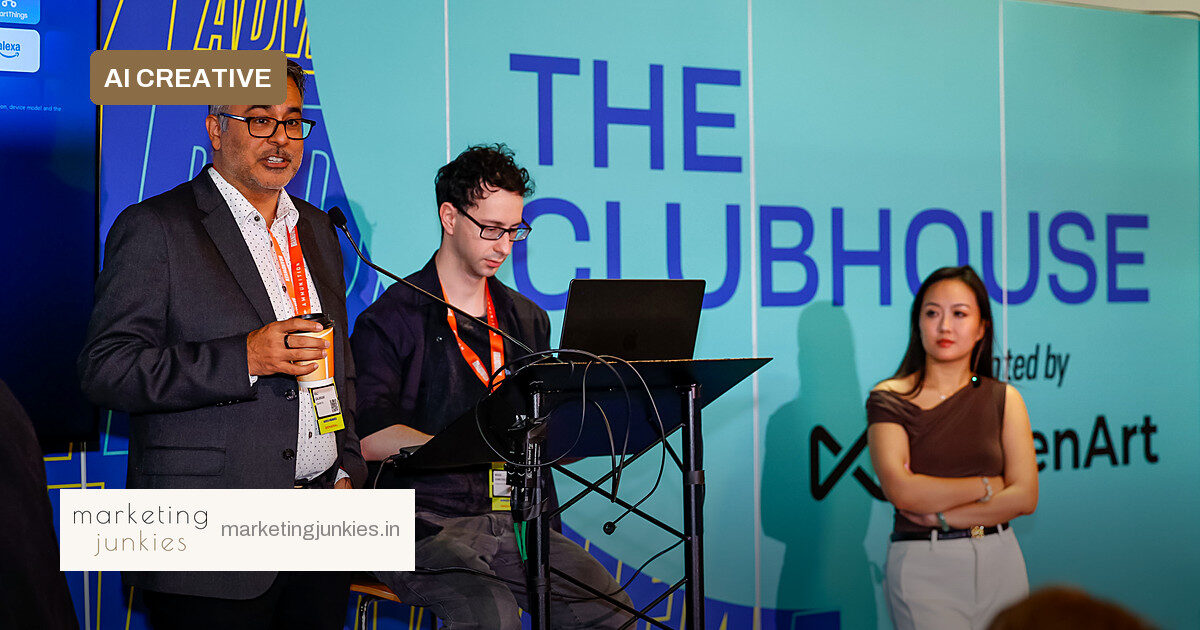
At The Clubhouse at Brandweek 2026, OpenArt ran three workshops on AI-powered campaigns and made the case that generative video has left its punchline era behind. In sessions with OpenArt’s Chloe Fang, head of enterprise GTM, and Raj Gajwani, chief business officer, the message to marketers was direct: AI is not here to replace creatives, but it can multiply what a team ships.
From punchline to production tool
The timeline matters. Gajwani described AI image and video tools four years ago as science projects. Two years ago, the internet was laughing at an AI-generated clip of Will Smith eating spaghetti. By late 2025, the tools had crossed a threshold: good enough for professional commercial work.
Fang frames that as a familiar pattern. Every leap in creative work has arrived with a leap in technology, not despite it. Gajwani expects the shift to become routine fast: a creative who says they are not using AI will soon sound, he said, like “a carpenter saying, ‘I’m not using a hammer.'”
Removing friction, not removing people
The more useful idea in the OpenArt pitch is friction. Many creatives fear AI removes the human, but Fang argues the opposite: “A lot of creatives think AI is removing the human, but actually it’s removing the friction to creativity.”
In that framing, a creative is still the visionary who conceives the idea, directs the tool, fixes the output and improves the result. Gajwani calls AI an Iron Man suit for creatives, not a robot built to replace them.
The workload does not shrink. When production costs drop tenfold, the brief can shift from 100 background swaps to 100 genuinely distinct ads. That is a different kind of output: more ideas tested, not one asset repeated.
Making scale safe
OpenArt’s enterprise answer pairs more than 100 models with controls for internal teams and outside vendors, plus what it describes as the industry’s first IP infringement checker. The aim is to bring that creative range into a governed workflow.
For marketing teams evaluating AI creative tools, the practical checklist looks like this:
- Look for model breadth instead of locking a team into a single engine.
- Check that brand controls, permissions and vendor workflows are built in.
- Confirm IP infringement checks happen before final export.
- Keep a human directing, fixing and approving every output.
Gajwani is clear about expectations: “There is no magic button. These are labor-saving tools.” The results may feel magical, Fang says, because ideas that once lived only inside a creative’s mind can now be visualized. But the work of judgement stays human.
For our readers, the takeaway is practical. AI creative is now mature enough for campaign production, but the strategic advantage goes to teams that adopt it with guardrails, not excitement alone.
Source: Adweek