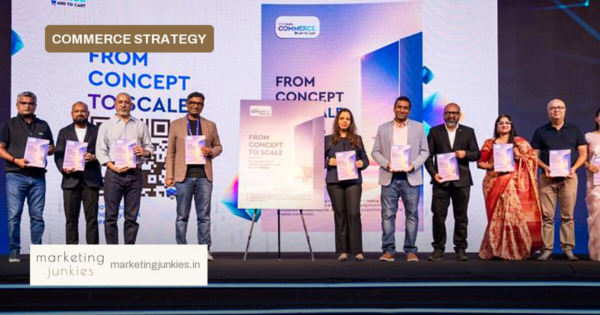

WPP Media India has released “From Concept to Scale: The Commerce-First Launch Playbook for India,” a framework that positions e-commerce platforms as more than distribution pipes. Unveiled on September 30, the report argues they are now testing grounds where brands can validate product ideas, spot high-potential consumer cohorts and reduce the cost of failed national launches.
Behaviour beats declared intent
The playbook’s central argument is blunt: what shoppers say they will buy is less reliable than what shoppers actually do. Instead of basing launch choices on stated intent alone, WPP Media recommends reading signals from live or simulated product listings—what people discover, click, consider, abandon, purchase, review and buy again.
For marketing teams, this is a shift from research-first to evidence-first launch planning. A brand can test a proposition in a controlled digital environment, collect real behavioural data and only then commit to national distribution.
Where the growth is shifting
The report points to two structural changes in Indian e-commerce. First, non-metro markets are no longer a secondary audience. Tier 2 and beyond cities accounted for roughly 65% of new e-retail shoppers in 2024–25, making them a core source of launch insight rather than an afterthought.
Second, quick commerce has become a genuine testing channel. The playbook cites a 16–17% share of India’s e-commerce gross merchandise value for quick commerce in 2025, with Bain & Company and Flipkart projecting the segment will contribute 45–50% of incremental e-retail GMV through 2030. Delivery windows of 10–20 minutes compress the cycle from discovery to repeat purchase.
Digital proof before offline scale
WPP Media is careful not to overstate the digital win. With around 90% of Indian retail still taking place offline, the playbook frames digital validation as the foundation for expansion into general trade, modern trade and specialised retail—not the final destination.
It also warns against treating channels as interchangeable. D2C platforms, marketplaces, quick commerce, retail media networks and creator ecosystems play different roles across discovery, intent, purchase and fulfilment. A coordinated launch strategy matters more than being present everywhere at once.
What the framework offers
To make the thinking operational, the playbook introduces a 90-day gated launch operating system, commercial health guardrails, a quick commerce entry framework and seven core questions for commerce leaders. The practical sequence looks like this:
- Validate the proposition through live or simulated commerce listings
- Track discovery, cart abandonment, reviews and repeat purchase as go/no-go signals
- Unlock offline and broader distribution only after demand repeats
Ashwin Padmanabhan, COO, WPP Media South Asia, said the opportunity is “not simply to launch faster, but to learn earlier, activate smarter, and scale with greater precision based on real shopper evidence.” Sairam Ranganathan, Head of Ecommerce, WPP Media India, added that the future of product launches in India is “decisively commerce-first.”
For brand managers, the takeaway is not that offline is dead. It is that digital commerce should come first as a low-cost evidence layer, and bigger bets should wait until the data justifies them.
Source: Indian Advertising Media & Marketing News – exchange4media