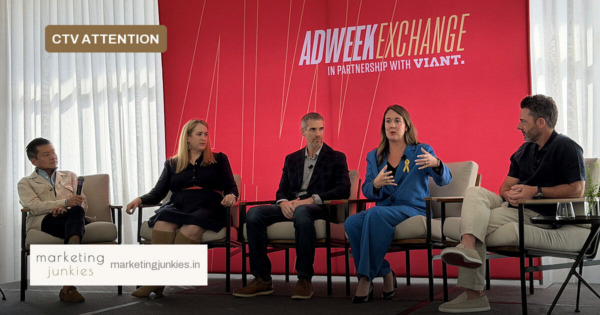


Advertisers still buy a lot of TV and streaming inventory on delivery signals such as completed views. But at ADWEEK Exchange in Detroit, the first stop of a national roadshow from Viant and ADWEEK, TVision CEO Yan Liu made the case for a different metric: attention.
The average U.S. consumer now spends 213.5 minutes a day with television and streaming video. About 24.5 of those minutes are advertising. Yet, according to TVision, only 9 minutes represent actual attention to those ads.
The gap between playback and attention
Liu said viewers are often in the room without watching, and ads sometimes play to an empty room. A completed view tracks that the ad played; it does not tell a marketer whether anyone paid attention.
The connection to business outcomes was striking. TVision examined hundreds of campaigns across 20 industries and found each percentage-point increase in attention corresponded to nearly a 1% increase in ad awareness.
Context also changes the outcome. Liu showed that the same creative drew more attention when it ran next to sci-fi and sports than next to news and reality shows. “It’s the same creative. It’s just different context,” he said.
Live context shifts attention too
Liu used a Thursday night NFL game between the Detroit Lions and Buffalo Bills to show how attention tracks the on-screen moment. Attention fell as the score widened and rose when the game became competitive in the third quarter. The second half drew more attention than the first, unusual for football, and fewer people were watching together after halftime.
The implication: placement, content genre, and even the live moment can make an identical ad more or less attention-worthy. That raises a practical question for brands: if the same ad can perform differently by context, how should budgets and creative decisions change?
What brands are doing with the signal
In a panel moderated by ADWEEK CEO Will Lee, marketing leaders discussed how attention thinking lands in real campaigns:
- Nutrafol CMO Deena Bahri said the brand’s recent hair-health campaign needed to express the same idea differently on TV, social and in-person, calling the balance between variety and consistency “the magic in great creative.”
- Rocket SVP Sarah Tarraf explained that for an infrequent purchase such as a mortgage, awareness must be built to last. After viewers remembered its Super Bowl ad but not the brand, Rocket put the brand more prominently in visuals and voiceovers and began using test and control groups to measure clicks, site visits and conversions.
- Viant COO Chris Vanderhook said Viant acquired IRIS.TV to see content within streaming apps rather than buying only at the app level, and found TVision’s attention data useful in predicting campaign outcomes.
Use attention mid-flight, not post-campaign
Viant CEO Tim Vanderhook closed the event with a simple operational shift: treat attention as an in-flight optimization tool, not a post-campaign scorecard.
“You cut low attention providers, and you reallocate your budget to the higher attention placements that are there,” he said.
His recommended starting point is one campaign: establish its current attention level, adjust creative and placements, and measure the result. That loops attention data into budget decisions while a campaign is still running.
For marketing teams, the takeaway is practical. Completed views tell you the ad was delivered. Attention data begins to tell you whether it was experienced, in what context, and with what likely impact.
Source: Adweek