
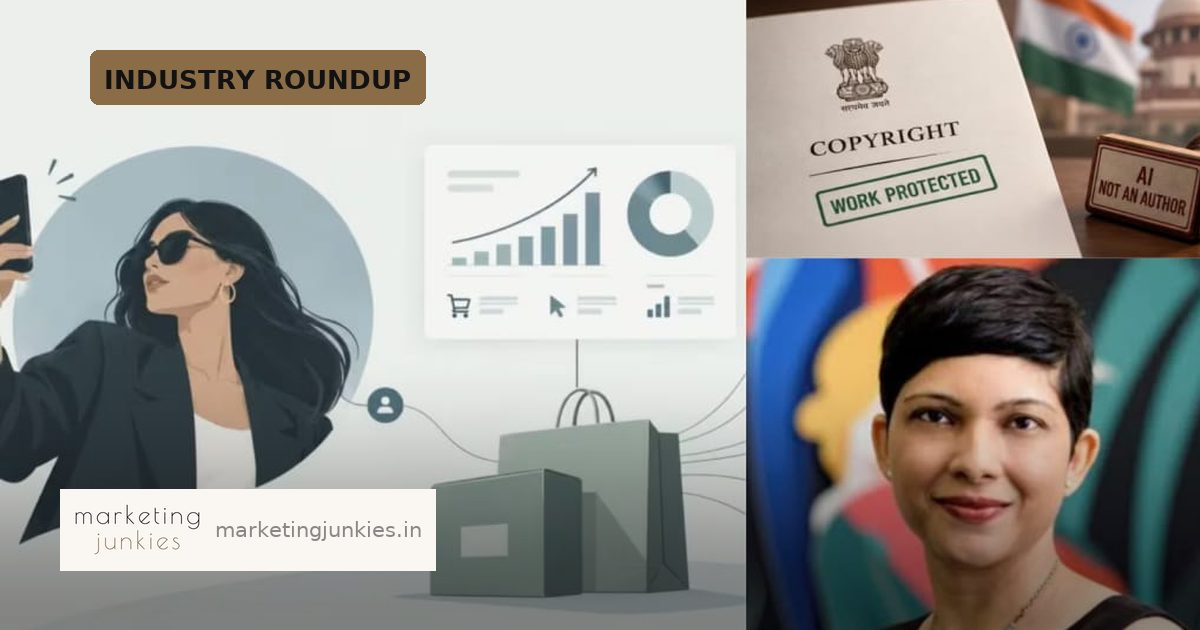
Three developments this week matter for anyone planning creator budgets, signing off on AI-generated assets, or buying video: D2C brands are pulling apart on influencer strategy, India’s Copyright Office has drawn a line on AI authorship, and YouTube is making a fresh push into premium long-form for the television screen.
D2C brands are no longer following one creator playbook
Influencer marketing is now a fixed line item in the D2C mix. Where that money goes, however, is diverging sharply.
Healthy snacking brand Farmley continues to put the majority of its influencer budget behind celebrities and macro creators. Medical apparel brand Knya has gone the other way, directing close to 80% of its creator spend towards micro and nano creators. Beauty brand ETUDE is optimising for something different again: niche relevance, audience quality and longer creator relationships rather than follower counts.
The backdrop is rising creator fees, which are pushing marketers to interrogate influencer ROI far more closely than they did a couple of years ago. Affiliate structures and performance-linked payouts are gaining traction as a result.
Why it matters: the “reach at any cost” phase of Indian influencer marketing is ending. When fees climb faster than conversion, category and funnel position decide the answer, not best practice.
A simple way to think about it:
- Low-awareness or new category? Macro and celebrity creators still buy you salience fast.
- Niche or professional audience? Micro and nano creators deliver credibility and cost efficiency, as Knya’s split suggests.
- Considered purchase with trust barriers? Long-term creator relationships beat one-off posts, which is broadly ETUDE’s bet.
- Performance-led mandate? Move part of the budget to affiliate or payout-linked deals so cost scales with outcome.
The practical takeaway for marketers: stop benchmarking your creator mix against other brands’ and start benchmarking it against your own contribution margin.
India’s AI copyright answer: no AI author, but the work can still be protected
Copyright law has always assumed a human somewhere behind an act of creation. Generative AI has been quietly stress-testing that assumption across ad campaigns, film credits, game studios and marketing decks.
India’s Copyright Office has now addressed it. In an order on American researcher Stephen Thaler’s application to register a digital artwork titled ‘A Recent Entrance to Paradise’, the Registrar of Copyrights held that a work created with the help of an AI system called DABUS can meet the legal threshold of originality, even though DABUS itself cannot be recognised as the author.
That distinction is the whole story. Protection is not automatically forfeited because AI was involved, but the AI cannot hold authorship. Human involvement remains the anchor.
What to do about it: if your brand or agency has AI-assisted assets sitting in a content library, start documenting the human contribution behind them – prompts, direction, editing, selection and final creative decisions. Build that record-keeping into your production workflow and your agency contracts now, rather than reconstructing it later during a dispute or a licensing negotiation.
YouTube goes after the biggest screen in the house
Balaji Telefilms and YouTube are extending their content partnership, with five premium shows to be produced in 4K and released directly on the platform. The move is part of YouTube’s push to strengthen its hold on long-form entertainment and Connected TV.
Gunjan Soni, Country Managing Director, YouTube India, said the platform reaches more than 75 million adults in India through living-room screens. Soni said in a social media post that a new generation of digital-first audiences wants “cinematic storytelling on the biggest screen in the house” alongside the flexibility to watch on their own schedule.
For media planners, this chips further at the old split between television and digital video. If premium, 4K, long-form programming increasingly lands first on YouTube, CTV buys need to be evaluated on reach and attention rather than shoved into a digital line item.
Also worth watching
The 57th GST Council meeting, originally set for September 12, has moved to October 7 because of the BRICS summit in New Delhi. Real-money gaming companies will be watching closely: with the 28% GST regime upheld by the Supreme Court, the live question is what happens to tax liabilities accumulated under earlier interpretations of the law – a sector that has been a meaningful advertising spender.
Separately, Terribly Tiny Tales is expanding beyond branded content and social storytelling into a larger studio and IP business, as parent Collective Artists Network pushes its storytelling capabilities across streaming, theatrical and newer formats including micro dramas.
Source: Storyboard18